

Boiler blowdown
During boiler operations, the water is heated and evaporated to get a stream. The concentration of dissolved solids therefore increases the boiler. In the same time, its facts that the water needs more energy to be evaporated increases the energy consumption. To prevent the scaling and control the energy consumption, the water contained in the boiler is discharged and replaced with feed water. This operation is called the blowdown. The blowdown is determined according to its concentration in dissolved solids and depends on the operation conditions and the design of the boiler.
Depending on the boiler design, the blowdown operation can be operated manually or continuously. Usually, most of the industrial systems can operate both. Manual blowdown allows to discharge the water when the water quality becomes closed to the limits of operation. The automatic blowdown allows to regulate the water quality and maintain the level of suspended solids inside the heater tank all the times. Different parameters can be measured to control the boiler water quality and estimate when a blowdown is necessary: Alkalinity, Level of Suspended Solids, Chloride, Silica, etc.
Boiler blowdown wastewater treatment
Boiler blowdown wastewater properties depend on pretreatment for makeup water and on number of cycles of concentration. In any case, the temperature, the pH and level of dissolved solids at least of the blowdown water must be adjusted before going to sewers. In specific cases, it can also be interesting to reuse the blowdown waste water especially in some areas where water is scarce.
Typical options for blowdown management include:
- Discharge to surface waters - Not possible for recirculating cooling because of water quality.
- Discharge to wastewater treatment plants - May require pre-treatment.
- Treatment and reuse - Water reuse options vary depending on the nature of water uses along with a broad range of other considerations, including water reuse laws and water availability.
- Zero liquid discharge (ZLD) - This alternative involves extensive treatment of blowdown to facilitate its reuse combined with volume reduction to minimize or eliminate the need for liquid discharge.
Boiler blowdown is a difficult stream to treat. A combination of technologies is required to get a stable operation. One of the most efficient used techniques is reverse osmosis. Reverse Osmosis membranes are used to separate dissolved ions and produce a high quality permeate. Required pre-treatment includes filtration, softening, pH adjustment, and/or ion exchange.
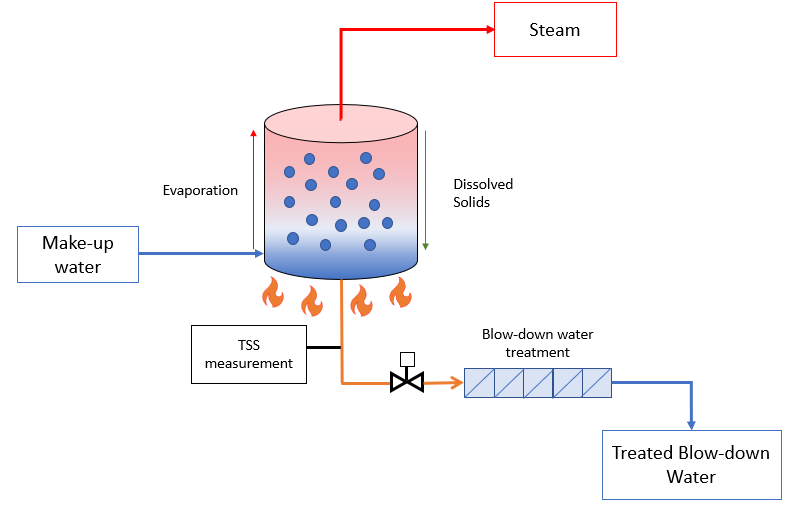
Figure 1. Diagram of boiler blowdown water treatment by reverse osmosis membranes
Benefits of blowdown water treatment include:
- less maintenance,
- lower fouling and corrosion,
- reduction of chemicals used,
- more stable water quality.
Overall water efficiency increases and almost 100% of blow down water can be reused.
Lenntech provides sustainable and complete solutions for blowdown water treatment and reuse considering a wide range of technologies and strategies. With worldwide growing water demand and water scarcity, our solutions are suitable for reducing boiler operational costs and water footprint.
Our advantages
- Engineered and custom designed solutions for unique cooling tower blowdown water treatment systems and specific equipment needs.
- Turn-key solutions including design, engineering, manufacturing, automation, installation, maintenance and training.
- State-of-art technologies for effective water and wastewater treatment, recycling, reuse, and disposal.
- Best on-line assistance and on-site service and support.
Boiler make-up water quality (pH, TDS, oxygen) shall be set according to the boiler pressure and type of heater. This will determine the blowdown quality.
Lenntech can provide you all water treatment equipment, including chemicals. Chemicals will condition the water and protect boiler equipment (heater, pump, …).
Lenntech can advise you on treatments required on the make-up water, by providing calculations on mass balance in the steam boiler, contributing for lower electricity consumption.
For more information or quotation, please contact us: Feedback Form or call us on +31 152 610 900