

Direct Contact Membrane Distillation
- Introduction
- Process Function
- Advantages and Disadvantages
- Process Industry Applications
1) Introduction
Membrane Distillation (MD) is a thermally driven transport process that uses hydrophobic membranes. The driving force in the method is the vapor pressure difference between the two sides of the membrane pores, allowing for mass and heat transfer of the volatile solution components (e.g. water). The simplicity of MD along with the fact that it can use waste heat and/or alternative energy sources, such as solar and geothermal energy, enables MD to be combined with other processes in integrated systems, making it a promising separation technique.
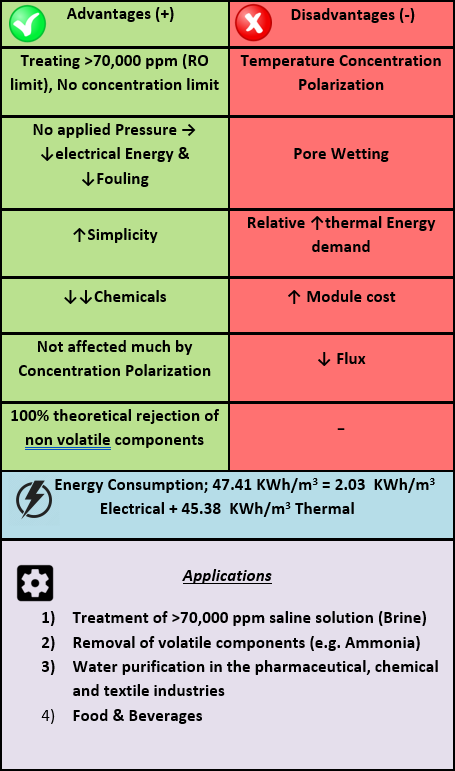
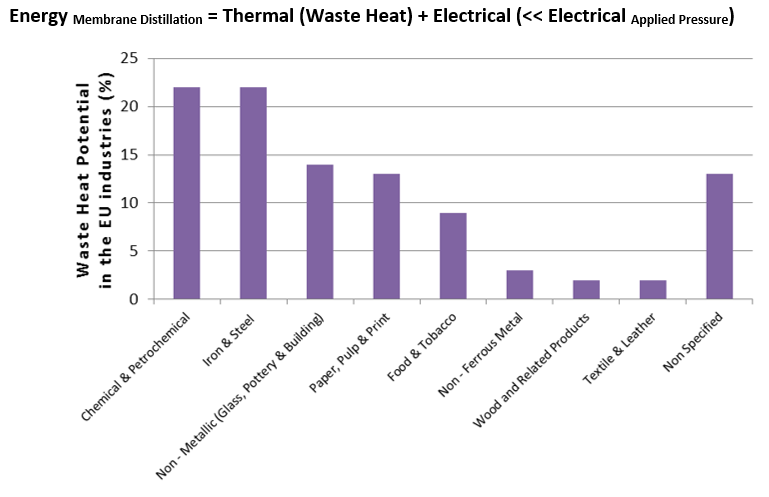
Fig.1, Waste heat potential per industrial sector in the EU (%), Preliminary assessment of waste heat potential in major European industries (2107)
2) Process Function
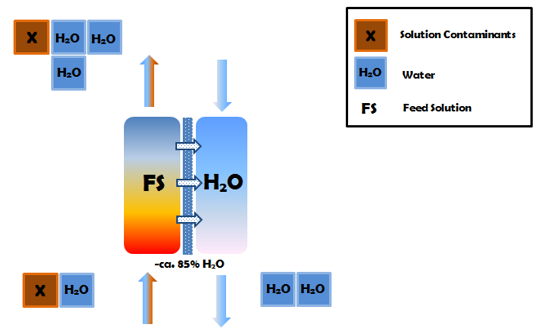
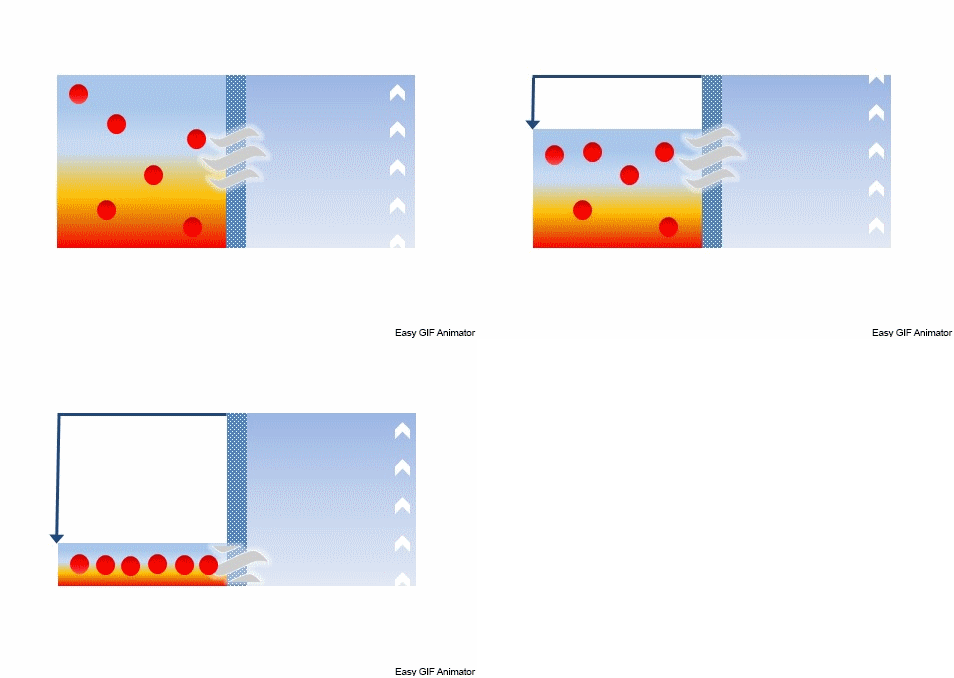
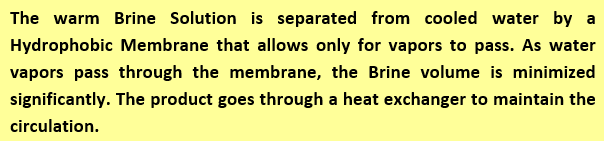
Fig.2, Simplified schematic of the MD process.
The driving force for MD process is given by the vapor pressure difference which is generated by a temperature difference across the membrane. As the driving force is not a pure thermal driving force, MD can be held at a much lower temperature (30-60oC) than conventional thermal distillation. The hydrophobic nature of the membrane prevents entry to the water molecules due to surface tensions. The latter doesn’t apply for the water vapors though, which create a pressure difference and travel through the membrane pore system, condensating on the opposite cool side of the membrane. The process removes ca. 85% water from the feed solution and can be summarized in three steps: (1) formation of a vapor gap at the hot feed solution–membrane interface; (2) transport of the vapor phase through the microporous system; (3) condensation of the vapor at the cold side membrane–permeate solution interface.
The way the vapor pressure difference is created across the membrane is determined by the MD module configuration. In the most commonly used configuration, direct contact membrane distillation (DCMD), the permeate-side consists of a condensation liquid (often clean water) that is in direct contact with the membrane. Alternatively, the evaporated solvent can be collected on a condensation surface that can be separated from the membrane via an air gap (AGMD) or a vacuum (VMD), or can be discharged via a cold, inert sweep gas (SGMD).
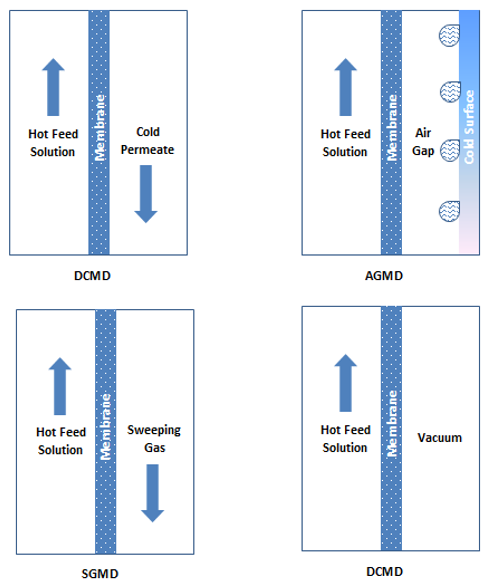
Fig.3, MD configurations.
The selection of the membrane is the most crucial factor in MD separation performance. There are two common types of membrane configurations,
- Hollow fiber membrane mainly prepared from polypropylene (PP), polyvinylidenefluoride (PVDF) and PVDF - Polytetrafluoroethylene (PTFE), composite material
- Flat sheet membrane mainly prepared from PP, PTFE, and PVDF
PTFE has the highest hydrophobicity, good chemical and thermal stability and oxidation resistance, but it has the highest conductivity which will cause greater heat transfer through PTFE membranes (thus reducing the temperature difference and the vapor transfer). PVDF has good hydrophobicity, thermal resistance and mechanical strength and can be easily prepared into membranes with versatile pore structures. PP exhibits good thermal and chemical resistance.
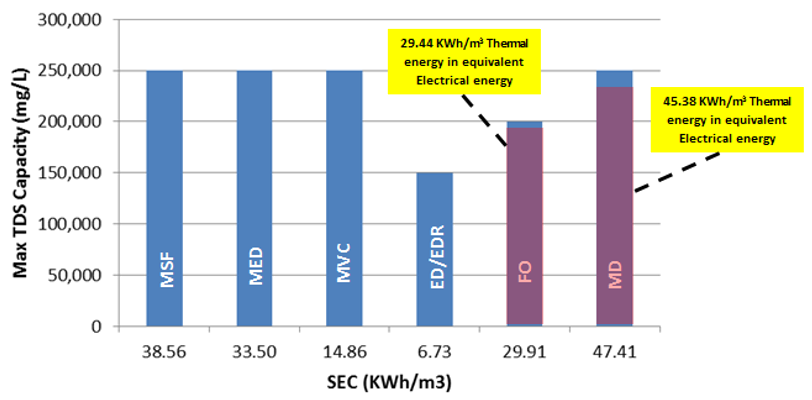
Fig.4, Specific Energy Consumptions (SECs) of Brine Treatment technologies in KWh/m3 versus their Max TDS Capacity in mg/L (ppm). In series we have Multi Stage Flash (MSF), Multiple Effect Distillation (MED), Mechanical Vapor Compression (MVC), Electrodialysis/ Electrodialysis Reversal (ED/EDR), Forward Osmosis (FO), Membrane Distillation (MD). FO and MD can make use of waste heat for up to 90% of their Thermal Energy Demand.
3) Advantages and Disadvantages
Advantages:
- Low energy requirements
- Isn’t affected much by Concentration Polarization
- 100% theoretical rejection of non-volatile components, no limit on feed concentration
The advantages of MD, in comparison with conventional separation methods are mainly the lower pressure and the low temperature requirements (30-60°C) which lead to lower energy costs and less taxing mechanical properties for the modules. Contrary to distillation and RO the feed solution can be separated at a temperature below its boiling point (at atmospheric pressure). With the low grade heat requirements the industrial waste heat can be used, as well as renewable energy sources such as solar, wind and geothermal.
Also in comparison with RO, MD is less susceptible to flux limitations caused by concentration polarization. Very low feed temperatures can produce reasonably high rates of product water and may be more practical considering the nature of some water impurities (e.g. scaling issues at high temperature). Theoretically, MD offers 100% retention for non-volatile dissolved substances, whereby there is no limit on the supply concentration.
Disadvantages:
- Relatively high energy consumption (although the energy source is low grade temperature)
- Relatively high module cost
- Low flux in comparison to other pressure driven membranes
- Surfactants or amphiphilic contaminants may cause wetting of the membrane (saline feed leaks through the membrane, contaminating the permeate)
The main factors that still hinder the industrial application MD are the relatively low permeate flux in comparison with pressure-based membrane processes, flux reductions caused by concentration polarization, fouling and pore wetting of the membrane, the high cost of MD modules and the high thermal energy consumption.
4) Process Industry Applications
|
 Membrane Distillation