

Reverse Osmosis Desalination membranes troubleshooting and cleaning
Reverse Osmosis membranes must be rinsed and chemically cleaned periodically, when stopped or when performances decrease by 10-15%.
- Post service rinse
- Chemical cleaning
- Troubleshooting guide
Post service rinse
Seawater flows tangentially along the membrane, creating an salt concentration gradient along the membranes length, the last element having the most concentrated brine bulk.
When the RO is stopped or in stand-by, natural osmosis will happen between the permeate side and the concentrate side containing high salinity brine. This can damage the feed spacers by creating a vacuum in the permeate line, as water will naturally flow back to the concentrate side, driven by osmotic pressure.
To avoid this natural damaging osmosis to happen, seawater and brine are flushed off the membranes after service by permeate water taken from the permeate tank (before chlorination) and pushed in the membrane by a low pressure pump (i.e., feed pump, distribution pump or specific cleaning pump)
Seawater flows tangentially along the membrane, creating a boundary layer on the membrane surface.
Membranes have to cleaned typically when:
- Normalized Permeate flow varies by 10-15%
- Normalized Feed pressure varies by 10-15%
- Normalized Permeate conductivity varies by 10-15%
- Pressure drop between feed and concentrate varies by 10-15%
Normalized values take into account temperature and salinity variations in feed water.
In order to ease chronicle cleaning, our systems can be equipped with cleaning In Place (CIP) station, readily connected to the membranes rack:
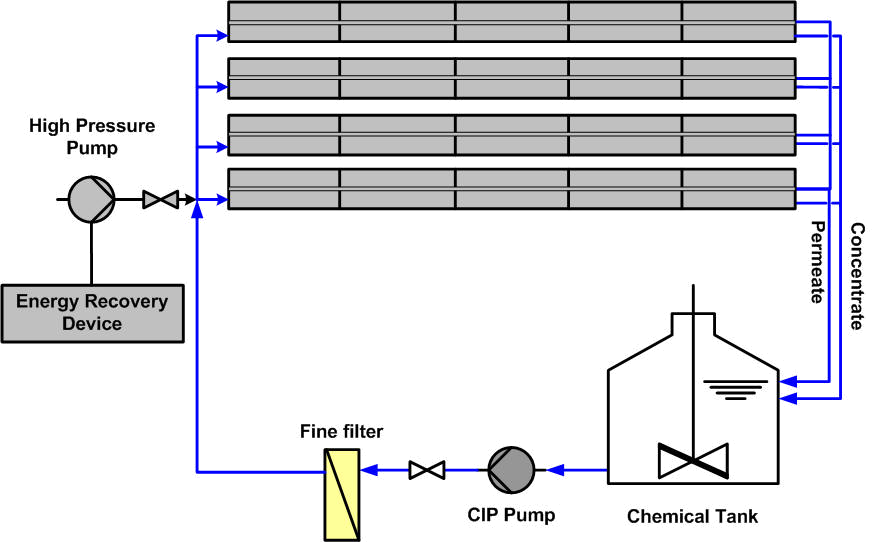
The CIP station, depending on the plant size includes a chemical tank with mechanical or manual stirrer, a CIP pump and a fine filter to avoid debris to enter the membranes. The chemical tank depends on the number of membranes to be cleaned at the same time.
Alkaline and Acid Cleaning solutions are recirculated around the membranes for at least 30 minutes.
We determine routine cleaning chemicals and procedures upon desalination plant layout and fouling identification:
RO Troubleshooting table: Analyzing the problem:
Permeate salinity |
Permeate flow |
Pressure drop |
Possible cause |
| rapid increase | rapid decrease | rapid increase | Metal oxide fouling |
| marked increase |
gradual decrease |
gradual increase | Mineral scaling |
| slight increase | gradual decrease | gradual increase | Colloidal fouling |
| normal to increased | decreased | normal to increased | Polymerized silica |
| decreased | marked decrease | marked increased | Biological fouling |
| decreased | decreased | normal to increase | Organic fouling |
| increased | increased | increased | Chlorine damage |
| increased | increased | normal to decrease | Abrasion damages |
| increased | normal to increase | normal to decrease | O-ring leaks at inter-connectors or adapters |
| increased | normal to increase | normal to decrease | Glue line leaks due to permeate back pressure |
Contact us for routine and specific cleaning procedures adapted to your system