

Diffusion Dialysis
Diffusion dialysis (DD) is an ion-exchange membrane (IEM) separation process driven by concentration gradient. Since the driving force for the separation process is mainly concentration gradient, diffusion dialysis is known as a spontaneous separation process.
DD is a membrane separation process. It has been successfully used for many years for the separation and recovery of acids from dissolved metal-bearing solutions. Diffusion is the spontaneous movement of a material from an area of high concentration to an area of lower concentration. Driven by the concentration difference, the movement of material will continue on its own until the concentration difference no longer exists. Dialysis is the separation of molecules due to the differences in the rate of movement of the molecules through a semi-permeable barrier.
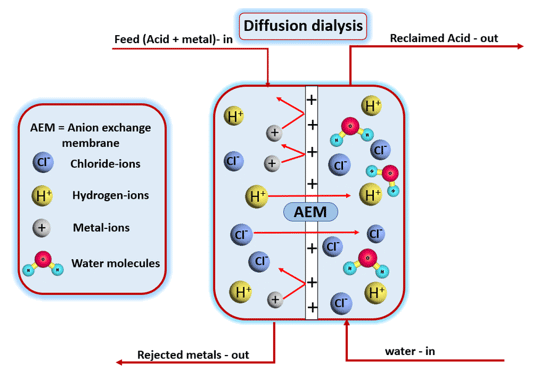
In comparison with some conventional processes, DD demonstrates significant advantages,
| a. | Higher efficiency in purifying wastewater; improvement on the productivity and quality of products. |
| b. | Low energy consumption (DD runs under normal pressure and has no state change during the process, so no power is needed for running DD). |
| c. | Low installation and operating cost; stable, reliable, and easy for operation. |
| d. | No pollution of the environment. |
To date, DD has been successfully applied for
| 1. | recovery of acids and alkalis from the discharges from steel production |
| 2. | metal-refining |
| 3. | electroplating |
| 4. | cation exchange resin regeneration |
| 5. | non-ferrous metal smelting, aluminum etching |
| 6. | tungsten ore smelting |
Nevertheless, DD also has its limitations, such as relatively low processing capability and efficiency thus it is considered less efficient than some other membrane separation processes, such as electrodialysis (ED).
However, the low environmental impact and energy consumption, may make DD more competitive as environmental pollution and energy shortage are prime project decision factors. Furthermore, with the improvement on ion exchange membranes and diffusion dialyzers, the processing capability and separation efficiency of DD can be substantially enhanced.
The membranes for DD can be either anion exchange membrane (AEMs) or cation exchange membranes (CEMs). The former is for the separation of acids with the corresponding salts and the latter is for the similar separation of base mixtures.
Due to the higher demands of acid recovery, more attention has been placed on AEMs compared to CEMs, and as such an increasing number of AEMs have been developed for DD applications.
Sulphuric acid (H2 SO4 ), hydrochloric acid (HCl) or a combination of hydrofluoric and nitric acids (HF + HNO3) is often used as pickling agents in industries for a variety of metals etching and stripping processes, such as steel production, metal refining, non-ferrous metal smelting. Large quantities of spent liquor are produced during the pickling steps.
Until now, different methods dealing with the acidic discharges have been applied, including cooling and crystallization, thermal decomposition, evaporation and crystallization, ion exchange, solvent extraction, distillation and electric-membrane separation methods, as well as direct disposal and neutralization with alkalis. Nevertheless, some inherent shortcomings still hinder their further developments and applications such as high investment for equipment, large consumption of energy and alkalis, and environmental pollutions.
In the recovery of acids with DD, an anion exchange membrane acts as a semi-permeable barrier placed between a flowing water stream and a flowing acid with dissolved metal solution. The anion exchange membrane has fixed positive charge located on its surface. These positive charge locations attract the negatively charged anions in solution that come in close contact with the anion exchange membrane surface.
For example, in the case of sulfuric acid anodize baths the overwhelmingly predominant anion is the sulfate ion, SO4. As these sulfate ions in the sulfuric acid anodize solution are attracted to the membrane they are also driven by the concentration difference to diffuse across the membrane to the water side.
Simultaneously, the thermodynamic Law of Electroneutrality (in solution total charge must balance to zero) requires that the transference of every sulfate ion, which carries two negative charges, be accompanied by the transference of two positive charges.
Positively charged ions, such as Al +3 or other metal ions, are strongly inhibited from crossing the positively charged membrane because of the repulsion between like charges. The hydrogen ion, present in the acid solution as H3O +1 ions, or protonated water, is also positively charged, but is able to cross the membrane with very little hindrance. This is due, in part, to the high concentration of hydrogen ion in the acid solution and also, in part, because of the highly associated nature of water, which allows the hydrogen ion to effectively delocalize its charge.
The net effect is that the rate of diffusion of an acid across the membrane is an order of magnitude greater than that of the dissolved metal. Finally, by causing the flow of the acid solution to be in the opposite direction to the flow of water (counter-current flow), optimal advantage of the necessary concentration gradients can be realized. The results are that the water entering the diffusion dialysis system exits as a metal-depleted recovered acid solution and that the acid solution entering the diffusion dialysis system exits as an acid-depleted dissolved metal-bearing solution.
After desired results are achieved, little maintenance or no maintenance at all is required on the unit. The metering pumps are typically automatically operated 24 hours per day, seven days per week.