

Electrodialysis for tartrate stabilization in the wine industry
The wine industry traditionally uses refrigerated bulk storage tanks for wine stabilization. After tartrate crystallization, precipitation, and settling, the clarified wine is decanted from the tank, filtered, and bottled. Without this processing step, tartrate crystals develop and appear as hard white crystals in the wine. This method presents an important drawback in terms of process time and energy required for colling. Electrodialysis (ED) is an energy-efficient alternative to cold stabilization.
The wine industry traditionally uses refrigerated bulk storage tanks for wine stabilization. After tartrate crystallization, precipitation, and settling, the clarified wine is decanted from the tank, filtered, and bottled. Without this processing step, tartrate crystals develop and appear as hard white crystals in the wine. This method presents an important drawback in terms of process time and energy required for colling. Electrodialysis (ED) is an energy-efficient alternative to cold stabilization.
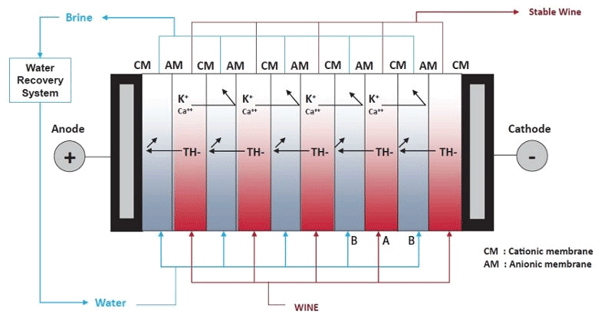
In wines, positively charged ions (as K+ and Ca2+) are separated from the negatively charged bitartrate ion (HT-) by pumping wine through the ED cell and applying a charged current. As the wine passes through the ED, the ions migrate from the wine towards a brine solution which collects them. The resulting wine has a minimized concentration of HT- ions, which makes it less likely to form and precipitate KHT crystals. Therefore, the wine is more cold and stable.
Lenntech can offer a fully-automated operation system that runs 24 hours per day. Moreover, preliminary predictive and verification tests can be done with a dedicated laboratory unit to confirm the degree of tartaric instability and design the process. Finally, Lenntech can provide an optional reverse osmosis unit to be coupled with the ED to reduce the overall water consumption from 50% to 90%.