

Lithium recovery from brines
Introduction
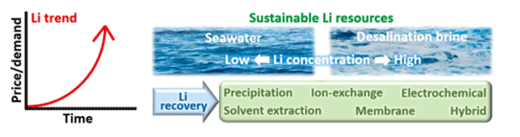
Lithium and its compounds are widely used in manufactured glass, ceramics, greases, batteries, refrigerants, chemical reagents and other industries. World lithium reserves are about 14 million tons, mostly 70–80% is stored in salt lake brine, geothermal water and solid lithium contained in lithium ore. Currently, many companies and organizations are turning their attention to 2,600 billion tons of lithium-containing seawater, which is about 15,000 times more than solid lithium ores.
Figures for lithium resources and reserves differ considerably accordingly to the source, although there is a unanimous agreement that lithium resources in brine are much larger than those in hard rock. The most recent figures indicate total lithium resources (brine + hard rock) to be 54.1 million tons. Approximate minimum and maximum hard rock lithium resources were reported at 12.8 and 30.7 million tons, respectively; while brine field data were reported as 21.3 and 65.3 million tons, respectively, for minimum and maximum estimates.
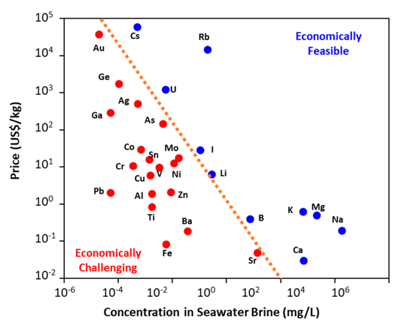
Figure 1, Element concentration and price (element concentration in seawater brine is estimated based on an average 40% recovery rate from a desalination plant).
Lithium has various uses, but its abundance in nature is only 0.0018%. The use of lithium on ceramics enriched with Li6 is up to 15% for use in the production of tritium. In addition, enriched Li6 is very expensive, what is commensurate with the value of gold. Consequently, it is necessary to extract and recycle lithium from the waste of solid breeding materials.
Lithium demand is expected to grow continuously and dramatically in the coming years as different types of lithium batteries are the most promising candidates for powering electric or hybrid vehicles. Lithium batteries include both current technologies such as lithium-ion and growing battery technologies such as lithium-sulfur or lithium-air.
Lithium demand is projected to increase by ~60% from 102,000 to 162,000 tons of lithium carbonate equivalent in the next 5 years, with battery applications taking a huge percentage of this growth. It was reported that the present lithium resource in continental and Salar brines is roughly 52.3 million tons of lithium equivalent, mainly in Argentina, Chile and Bolivia, from which 23.2 million tons can be extracted. From the other side, lithium from mineral resources is 8.8 million tons, where there are huge deposits in the United States, Russia and China. Evans estimated lithium reserves and recoverable resources at 29.79 million tons.
Meanwhile, the general public mainly associates lithium batteries with portable electronics and electric and hybrid vehicles, large storage capacity lithium batteries are also a lead candidate for a possible energy storage solution for the electric grid, intelligent network, etc. Batteries with large capacity are needed to store green energy, wind, that is, sun and waves, all this by their nature intermittent sources of energy.
Nowadays battling to achieve a greater percentage of green energy, high-capacity batteries or energy banks are mandatory. Basically, if in the near future we want our energy matrix to be highly dependent on renewable energy, energy banks will be needed to provide continuous energy to the grid, during the time these intermittent energy sources are either off or not working completely (no wind, no waves, at night. After all, on its own of the energy source, high-capacity batteries are also an alternative for storing energy during periods of low demand, allowing this excess energy to be re-injected into the grid at high demand peaks.
Currently, lithium is relatively not expensive (a ton of Li2CO3 is about 15,000 USD), the market shows that, its price is rising with increasing demand. In China, lithium prices have risen about 300% since 2016, and contract prices for existing manufacturers have risen to more than 16,000 USD per ton.
Lithium extraction from seawater
In the near future, to meet the needs of the world community in lithium, the ocean is considered the most important and promising resource for lithiu. It is reported that the total amount of lithium reserves in the oceans is approximately 2.6 × 10¹¹ tons.
Because of the exhaustion of lithium ores, recent studies have shown recovery of lithium from seawater, brine and geothermal water. Production of lithium from water resources has become more important due to its wide availability, ease of process and cost-effectiveness compared with its production from various resources. Further, extraction of Li from concentrated brine is estimated to cost from 30% to 50% less than that from mined ores. If metals are economically recovered from the brine concentrate, not only can the water production cost be reduced by the revenue from the minerals recovered but also the environmental problems associated with brine disposal can be reduced. It is safe to say that extraction of elements from brine would support a more sustainable economy.
Many methods for extracting lithium from seawater, brines and geothermal water have been reported: solvent extraction, including precipitation, liquid-liquid extraction, selective membrane separation, electrodialysis, ion exchange adsorption, etc.
Lithium extraction from brine
Extracting lithium from brine is an important potential resource. When considered from an economic perspective, the following points are important to consider lithium recovery from brine:
- Suitability of pond soil and admissibility of the area for solar evaporation
- The concentration of lithium in brine
- The ratio of alkali metals and alkaline earth elements to lithium
- The complexity of the phase chemistry
The resources of brines containing lithium can be divided into three types:
- Evaporative
- Geothermal
- Oilfield brines
Conventional Methods for Lithium Extraction/ Evaporation Ponds
Classical methods to extract Lithium rely on brine evaporation in open ponds to maximize the element concentration for further purification; however, these methods are very slow (evaporation of ponds to the desired level can take up to 24 months) and strongly dependent upon the weather conditions that are region-specific and vary throughout the year. More advanced technologies based on precipitation, adsorption, solvent extraction and membranes are being developed at the laboratory and commercial scale for brine concentration that can potentially increase the economic viability of minerals extraction from seawater and other geothermal brines.
Li-containing brine obtained from the source is initially concentrated to an appropriate concentration (around 6,000 ppm Li) for viable recovery. This is often achieved by the evaporation of raw brine in large open-air shallow ponds via solar irradiation and wind. Figure 2 shows the schematics of the conventional evaporation process. Depending upon the nature of brine and environmental conditions, the evaporation can be carried out in multiple steps while harvesting salts of other elements such as Na, Mg and K. The final brine, which is rich in Li chloride, is subsequently pumped to the treatment plants where further chemical reactions are carried out to obtain commercial-grade Li carbonate which then serves as the main raw material to produce desired Li compounds or Li metal.
This evaporative method is time-intensive and not applicable at all geographical locations due to significant variations in climate. In addition, the efficiency of this method is heavily dependent upon the brine composition which varies greatly from one location to another. The presence of other ions in a higher concentration may cause their co-precipitation that will further complicate the Li recovery process. For instance, Mg2+ ions possess very similar chemistry to that of Li+ ions and they can co-precipitate as Mg carbonate along with Li carbonate which greatly complicates further recovery of the desired Li salts. More importantly, evaporative technologies accompanied by severe water loss might also lead to water scarcity in the surrounding areas as observed in Chile
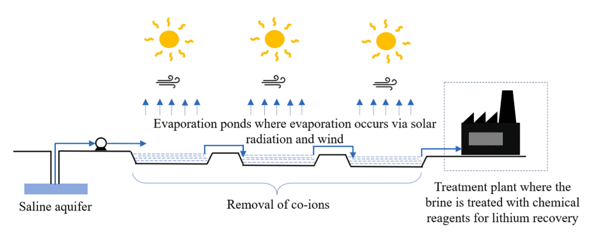
Figure 2, Schematics of the brine evaporation process for Li recovery
Evaporation
In the process of evaporation of the brine about 50% of the original natural brine, lithium remains in the residual brine. This expression has been ascribed to the retention of lithium by precipitated salts. Residual brine is highly loaded with Mg2+ as compared with K+ and Na+, this makes it difficult to extract lithium from this residual brine.
The extraction of lithium from brine does not correspond to any general regularity since each process is specific depending on the composition of the brine field. Typical lithium production technology used for lithium extraction where different methods such as precipitation, solvent extraction and filtration were used (Figure 3).
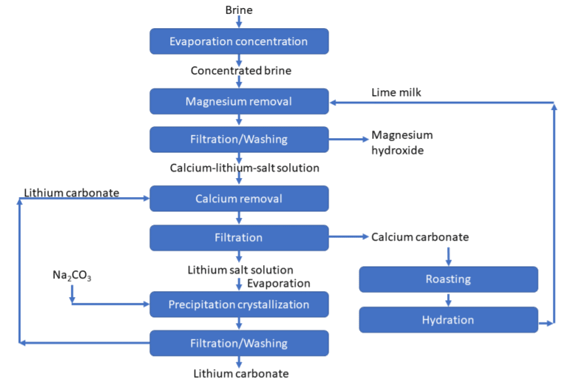
Figure 3, Flow-chart for lithium extraction as lithium carbonate from salar brine
Co-precipitation method for extracting lithium from seawater
Like other methods, it has not received wide application the extraction process of lithium recovery and extraction by co-precipitation. For lithium recovery, an important problem is the presence of higher concentrations of alkali and alkali metals in seawater. The alkali metal group has a very similar parameter, which creates problems for lithium recovery. The problems associated with lithium recovery from seawater and terrestrial hydromineral resources are very similar. To extract lithium from seawater, various reagents such as potassium, iron sulfates and aluminum hydroxides, are successfully used to co-precipitate lithium. To obtain lithium concentrate, the dissolution of the co-precipitate after an ion exchange process is used.
Ion exchange and sorption method for extracting lithium from seawater
Lithium selective ion exchange sorbents are a promising alternative for extracting lithium from brines. Inorganic ion exchange sorbents, such as lithium manganese oxides, spinel lithium titanium oxides, and lithium aluminum layered double hydroxide chloride, have been shown to have high lithium-selective uptake capacity. However, the recovery process requires the lithium to be in contact with these sorbents for long periods of time. Additionally, sorbents can be very expensive; they are mostly available as powders that require energy-intensive processes for lithium recovery and can degrade during the acid-driven desorption process.
Liquid-liquid extraction method of recovery of lithium from seawater
Scientists reported that liquid-liquid lithium extraction from seawater and liquid-liquid extraction are considered a potential process for extracting lithium from seawater. The use of liquid-liquid extraction to extract lithium from seawater is very limited, but the separation, purification and extraction of lithium by liquid-liquid extraction have been considered by several entities.
Membrane process recovery of lithium from seawater
Utilizing nanostructured membranes, having a pore size in the range of sub-nanometer to few nanometers, has gained a lot of interest for Li recovery. This technology is promising due to its advantages of better energy efficiency, ease of operation and process continuity. Although several membrane-based methods have been employed at the laboratory, pilot as well as the commercial scale for extracting Li from brine, ‘nanofiltration’ (NF) and ‘electrodialysis’ (ED) have been, by far, the most prevalent ones at all scales due to their moderate cost, low environmental foot-print and higher selectivity.
Besides these, several novel approaches to recover Li through hybrid systems have been reported in recent years. These include ion-imprinted membranes (IIM), Li ion sieve membranes (LISM), membrane distillation crystallization (MDC) and membrane capacitive deionization (MCDI). IIMs have gained significant attention due to their superior performance over conventional membrane adsorption systems
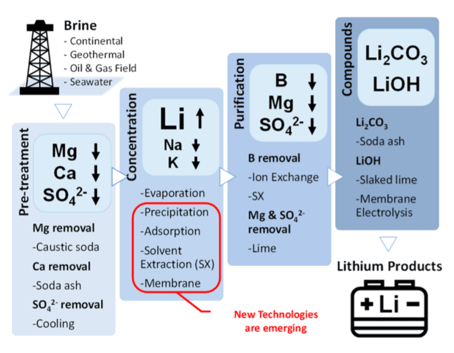
Figure 4, Li production process from brine sources. In the pretreatment, divalent ions are removed from brine as precipitates. Li is concentrated in the next step by rejecting other monovalent ions such as Na+ and K+ ions. Some impurities such as B in the Li concentrated solution are removed and lithium carbonate or lithium hydroxide is produced as a pure Li compound.
Li Recovery Outlook
From the extensive research so far, it is evident that the low concentration of Li in the seawater brine concentration is the main hurdle towards the sizeable implementation of new technologies. However, the seawater RO brine, which is several times more concentrated with Li, is an attractive candidate for high yield Li recovery through the use of novel technologies. On average, the daily global production of seawater RO brine is nearly 141.m3 which is discarded back to the oceans as waste. According to rough estimates, seawater RO brine can carry up to 0.3 mg/L of Li which translates to about 42 tons of Li being discarded back to the oceans on daily basis. Given the current market price of Li metal as 34 USD/kg (increased 7 times during the year 2020–2021), nearly 1.5 million USD are thrown back to the oceans as waste in the form of Li. These massive figures call for urgent implementation of modern technologies to efficiently recover Li and other useful minerals from the seawater RO brine. It is to be noted; however, that the seawater RO brine is concentrated with several other unwanted minerals at the same time which poses additional challenges for selective Li recovery. In order to tackle this, the current water desalination technologies need a holistic modification, focusing mainly on the pretreatment methods. From the grass root level, the methods and procedures should be designed and optimized to target both the fresh water and Li (and potentially other useful elements such as Co and U) as the primary products of the desalination process, thereby implementing the ‘waste- to-wealth’ concept in the desalination industry.