

UHPRO Ultra High Pressure Reverse Osmosis
The main modern means for desalination is by means of Reverse Osmosis Demineralization. In the recent years it’s been adapted into more demanding applications such as the treatment of industrial wastewater effluents.
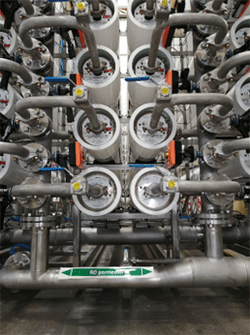
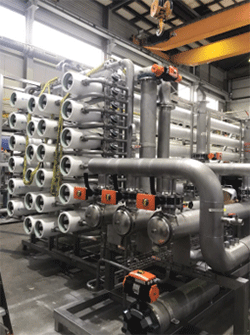
The main challenges of industrial wastewaters for membranes processes are a) scaling/fouling Antiscalants and b) brine management.
- a) Potential scaling of the membranes limits the water recovery which means increased brine volumes and high disposal costs of the latter. Scaling potentials also leads to increased membrane maintenance and replacement.
- b) Brines treatment are associated with high costs Brine-treatment which can an otherwise promising water resources not viable for reuse.
The reverse osmosis operation comprises of high pressure applied in order to drive water through semipermeable membranes that reject salt ions. Higher system recovery (more water produced, more salts concentrated) results in higher driving pressures which increase with higher brine concentrations and reduces freshwater permeate flux, requiring larger membrane area.
The maximum operating pressure for a standard sea water RO membrane is typically around 80 bar in order to overcome the retentate osmotic pressure of seawater treated to 50% recovery (∼70,000 mg/L; π ≈ 59 bar). Because of hydraulic-pressure limitations of RO, hypersaline brines (≥70000 mg /L), could be further treated via thermal processes Evaporation Crystallisation.
Thermal technologies are used to concentrate brine streams to approximately 250,000 mg/L (π≈290 bar). Thermal-based brine crystallizers then concentrate the waste stream above its solubility limit (e.g., 357,000 mg L/1 for NaCl) to extract solid salts for disposal. These technologies typically present high CAPEX and specially high OPEX (high energy required for the process).
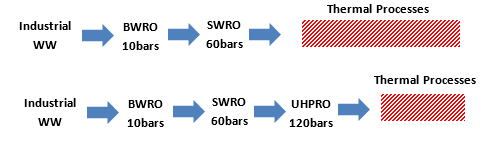
With recent developments on RO membrane market, ultra-high-pressure reverse osmosis (UHPRO) spiral wound membranes have been developed capable of withstanding 1800 psi (120 bar). UHPRO membranes enable the concentration of saline streams up to 130,000 mg/L total dissolved solids (TDS) for NaCl and 150,000 mg/L for Na2SO4 which means a 50% decrease in brine volume comparing to the standard types of membranes.
This results in more fresh water produced and less brine to be disposed or further treated by thermal technologies
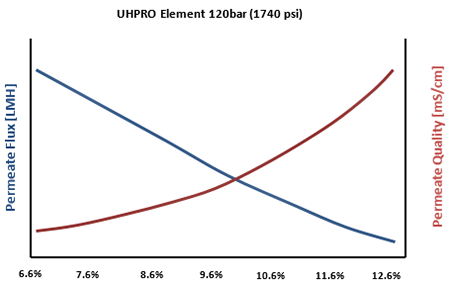
Reject Brine TDS %(mg/L)
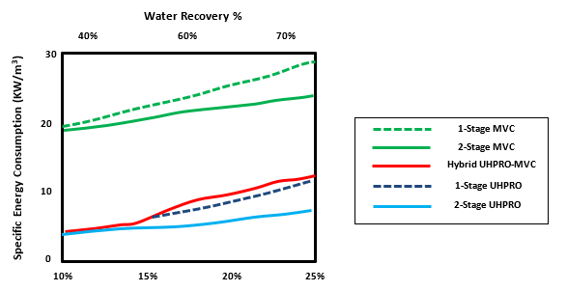
Reject Brine TDS %(mg/L)
| Characteristics of Significant Brine Sources and Current Disposal Practices | ||
|---|---|---|
| Brine Wastewater | Typical TDS (mg/L) | Current Disposal Practice |
| Oil&Gas produced water | 13,000-210,000 | Direct ocean discharge, deep well injection, reuse for hydraulic fracturing, evaporation ponds |
| Brackish groundwater | 5,000-55,000 | Surface/ sewer discharge, deep well injection |
| Flue gas desulfurization (FGD) wastewater | 16,000-50,000 | Settling ponds, chemical precipitation and surface discharge, zero liquid discharge |
| Landfill leachate | 0-50,000 | Land application, recirculation to landfill |
| Coal to Chemicals wastewater | 2,000-16,000 | Zero liquid discharge |
| Textile industry wastewater | 1,500-30,0000 | Zero liquid discharge, chemical & biological treatment prior to surface discharge |
The capital cost of UHPRO systems is higher than the cost of brackish or seawater RO systems but much lower than thermal evaporators. UHPRO can be applied upstream of evaporators, to reduce the latter’s size which means less CAPEX & OPEX for the thermal processes. Typical brine concentration limits and volume reduction ratios are summarized below.
| Technology | TDS brine limit (mg/L) | Brine Volume Reduction relative to SWRO |
|---|---|---|
| SWRO (1,200 psi) | 80,000 | 1.0x |
| UHPRO | 130,000 | 1.6x |
| Evaporator (thermal/MVR) | 220,000 | 2.8x |
UHPRO is increasingly being used in industrial effluents treatment processes for Zero Liquid Discharge (ZLD) and Minimal Liquid Discharge (MLD) applications. The result: far less thermal desalination is needed to achieve the same ZLD and MLD treatment objectives.
Lenntech provides customized solutions for brine concentration, considering a wide range of technologies and strategies. We can provide you high pressure RO with spiral wound membranes or disc filtration RO, for more challenging applications.
For more information or quotation, please contact us:  Feedback Form or call us on +31 152 610 900