
R&D pilot testing capabilities for water and brine treatment
Lenntech supports industrial water and brine treatment projects through applied research & development (R&D) and pilot‑scale testing, enabling the transition from concept and laboratory evaluation to full‑scale implementation. These activities are dedicated to validating, optimizing, and scaling advanced separation processes for complex and challenging water streams.
Lenntech R&D and pilot facilities focus on ion exchange, pressure‑driven membrane technologies such as ultrafiltration, nanofiltration and reverse osmosis and electricity‑driven separation technologies, including electrodialysis (ED) and bipolar membrane electrodialysis (BPMED). Together, these capabilities support selective separation, concentration, recovery, and conditioning processes under realistic industrial operating conditions.
Application areas covered
Lenntech R&D and pilot activities address a wide range of industrial water and brine treatment applications, including:
- Brine treatment and volume reduction
- Selective ion separation and fractionation
- Water recovery from complex and high‑salinity streams
- Separation of organics versus inorganics
- Chemical solution (acid and base) production and recovery
- Process water conditioning and reuse
- Lithium brine treatment and post‑extraction processing
These applications are relevant to most industries such as mining, energy, chemicals, advanced materials processing, and water reuse.
R&D approach – from concept to industrial solution
Lenntech applies a structured and data‑driven approach to R&D and piloting:
- Feed‑water characterization and process definition
Identification of salinity, target components, fouling risks, and separation objectives. - Laboratory evaluation
Feasibility testing of membranes, ion‑exchange resins, and electricity‑driven separation technologies under controlled conditions. - Pilot‑scale validation
Verification of separation performance, recovery, selectivity, energy demand, and operational stability using representative feed waters. - Scale‑up and engineering support
Translation of pilot results into reliable parameters for full‑scale system design.
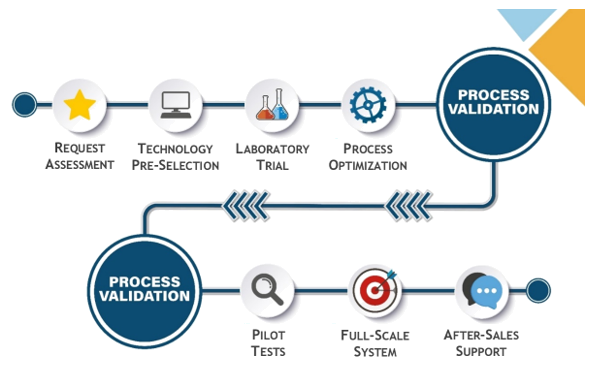
This approach reduces technical risk, allows process definition, characterization and optimization and supports robust, evidence‑based technology selection.
Technologies available for testing
Lenntech R&D and pilot facilities support a broad portfolio of membrane‑based and electricity‑driven separation technologies, including:
- Ultrafiltration (UF) – polymeric and ceramic material and flat-sheet, hollow-fiber, tubular and spiral-wound geometry
- Nanofiltration (NF) – including selective and staged configurations
- Reverse Osmosis (RO) – standard, high‑pressure, and closed‑circuit RO (CCRO)
- Ultra‑High‑Pressure RO (UHPRO) and ultra‑high‑pressure NF
- Ion Exchange (IEX) – for polishing, hardness reduction, and selective removal
- Electrodialysis (ED)
- Bipolar Membrane Electrodialysis (BPMED)
Technology selection is driven by feed‑water chemistry, separation objectives, and operating constraints rather than by fixed pilot configurations.
Pilot system capabilities
Pilot‑scale testing forms a central element of Lenntech’s R&D activities. Lenntech operates a diverse and flexible portfolio of pilot systems, enabling realistic testing of advanced water and brine treatment processes at an industrially relevant scale.
Pilot testing can be carried out on‑site at client locations, allowing direct evaluation on real process streams under representative operating conditions. It allows for process parameters tuning and assessment of long-term operational parameters including cleaning frequency.
In some specific cases, limited pilot testing can also be performed in‑house at Lenntech facilities, using controlled conditions and dedicated infrastructure. However, in‑house testing is typically restricted to short‑duration trials to support laboratory feasibility study.
With more than 20 pilot units available, all systems are designed as skid‑mounted units, with selected pilots available in containerized configurations to simplify transportation and on‑site implementation.
- Typical operating ranges of pilot systems
Rather than focusing on individual pilot units, Lenntech pilot capabilities are defined by a broad and representative range of operating conditions.
| Parameter | Typical Range |
| Feed flow rate | 0.5 to 8 m³/hr |
| UF operating pressure | up to 6 bar |
| NF / RO operating pressure | up to 40 bar |
| Stages high-pressure NF / low-salt-rejection RO | up to 80 bar |
| Ultra-high-pressure RO / NF | up to 120 bar |
| Electrical driving force (ED/BPMED) | application -dependent |
These ranges allow testing of highly concentrated brines, selective separations, and high‑recovery scenarios under realistic conditions.
- Pressure-driven membrane pilot units
Lenntech pilot facilities include a wide range of membrane‑based platforms designed to evaluate separation, concentration, and recovery processes for complex feed waters.
Key capabilities include:
- Adjustment of operating pressure, recovery, and cross‑flow velocity
- Single‑stage or multi‑stage membrane arrangements
- Testing of high‑salinity and high‑pressure operating regimes
- Evaluation of fouling and scaling tendencies
- Integration with upstream filtration or downstream polishing steps
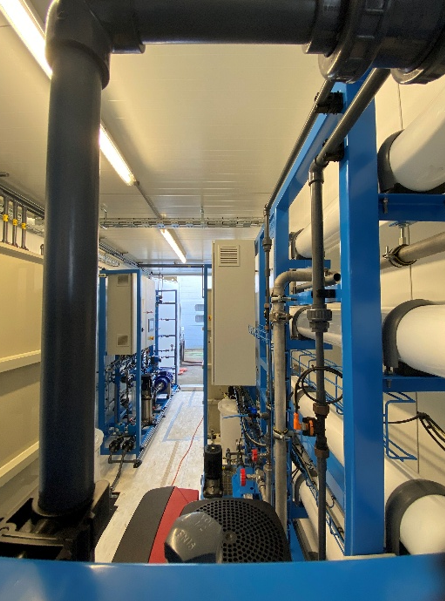
Illustration of containerized pilot unit set-up
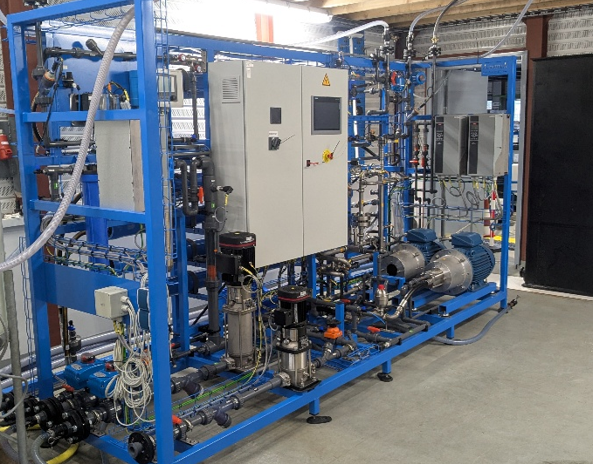
Illustration of stand-alone pilot unit skid
- Electricity‑driven separation pilot units
In addition to pressure‑driven systems, Lenntech operates pilot platforms based on electricity‑driven separation technologies, enabling evaluation of processes not achievable by membranes alone.
Available pilot capabilities include:
- Electrodialysis (ED)
- Bipolar membrane electrodialysis (BPMED)
These systems support controlled testing of ion selectivity, concentration, current density, voltage, and chemical production or pH modification.
From pilot testing to full‑scale implementation
Pilot operation produces detailed operational data, including:
- Separation performance and selectivity
- Recovery limits and concentration factors
- Fouling and scaling behavior
- Energy consumption and electrical demand
- Process stability under variable conditions
These data are directly used to:
- Define full‑scale design parameters
- Select suitable technologies and materials
- Reduce scale‑up uncertainty
- Support integration into existing industrial installations
Applied R&D and pilot testing support
Lenntech supports water and brine treatment projects through a structured R&D and pilot testing framework, dedicated to the validation and scale‑up of innovative applications and separation technologies.
Lenntech scope includes:
- Applied R&D for specialty and emerging water and brine treatment applications
- Laboratory testing and pilot trials
- In‑house and on‑site pilot testing
- Process optimization and troubleshooting
- Interpretation of results and scale‑up support
These capabilities support projects from early feasibility through to industrial deployment of innovative technologies at full scale.
For more information or quotation, please contact us:  Feedback Form or call us on +31 152 610 900