

Brine chemistry and selectivity considerations in Direct Lithium Extraction
The performance of Direct Lithium Extraction (DLE) technologies depends strongly on the chemical composition of the brine being treated. Natural and industrial brines - whether derived from salars (salt‑flat brines), geothermal reservoirs, or oilfield produced streams - can exhibit substantial variation in total dissolved solids (TDS), competing ions, organic content, and suspended matter. These characteristics influence both the efficiency of lithium capture and the selection of pretreatment and extraction systems.
Understanding brine chemistry is essential for designing stable, high‑performance DLE plants capable of operating under diverse mineral compositions and operational conditions.
Importance of brine composition in lithium extraction
Brines typically contain a mix of dissolved salts dominated by sodium, potassium, magnesium, and calcium ions. DLE materials — such as sorbents, ion‑exchange resins, membranes, or solvents — must selectively capture lithium despite these competing species.
Key parameters that influence extraction:
- TSS (total suspended solids)
- Total dissolved solids (TDS)
Some brines can exceed 100,000 mg/L TDS, which can influence:
- Scaling potential
- Viscosity and flow characteristics
- Pretreatment requirements
- Material selection for corrosion‑resistance
Higher TDS levels typically require more robust materials and fouling‑mitigation strategies.
- Competing cations
Lithium has to be separated from high concentrations of:
- Sodium (Na⁺)
- Potassium (K⁺)
- Magnesium (Mg²⁺)
- Calcium (Ca²⁺)
These ions compete with lithium for binding sites and can reduce extraction efficiency. Selective DLE materials are engineered to exploit lithium’s distinct chemistry and hydration properties to minimize these effects.
- Trace species
Iron, silica, boron, sulfates, hydrocarbons, and natural organic matter can interfere with extraction, foul media, or increase regeneration frequency. These species must be removed or stabilized during pretreatment.
- pH and alkalinity
Certain DLE medium exhibit optimum performance within specific pH ranges. Brine conditioning may be required to maintain stable operation.
Brine variability across different sources
Each brine type presents unique challenges and opportunities for extraction.
- Salar brines (salt‑flat brines)
Salar brines may have high lithium content but often contain elevated magnesium or calcium, making selectivity critical. Because each salar has distinct mineral compositions and TDS levels, DLE systems must be tailored to local brine conditions.
- Geothermal brines
These brines contain dissolved minerals and metals resulting from prolonged water‑rock interaction at high temperatures. Typical characteristics include:
- High silica and iron concentrations
- Elevated temperature
- Variable lithium content
These factors affect pretreatment requirements and material compatibility but offer opportunities for stable, continuous extraction.
- Oilfield Produced Streams
Produced water can contain hydrocarbons, suspended solids, organics, and high TDS. Pretreatment — including oil–water separation and clarification — is necessary to protect DLE systems from fouling.
Although complex, these brine streams represent a growing strategic resource where lithium recovery can be integrated into existing industrial infrastructure.
Selectivity challenges and system design considerations
Efficient DLE operation requires a balance between selective lithium capture and robust pretreatment.
- Selectivity optimization
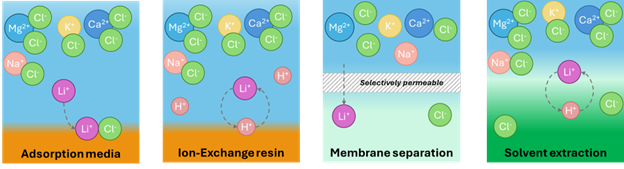
DLE technologies are designed to differentiate lithium from competing ions through:
- Tailored adsorption surfaces
- Ion‑exchange functional groups
- Lithium‑permeable membranes
- Lithium‑complexing organic phases
These mechanisms exploit lithium’s smaller ionic radius and high hydration energy to improve selectivity.
- Pretreatment to stabilize brine chemistry
Pretreatment helps mitigate:
- Scaling caused by calcium, magnesium, or sulfate
- Fouling from hydrocarbons or suspended solids
- Precipitation of iron or silica
- Membrane clogging or resin deterioration
Stable pretreatment improves extraction efficiency and extends the operating life of DLE materials.
- Need for tailored system design
Because every brine has its own chemical fingerprint, no single DLE configuration works universally. Systems must be adapted to:
- Ionic ratios
- TDS levels
- Temperature
- Trace contaminants
This customization is essential for ensuring stable long‑term performance and achieving high lithium recovery.
How Lenntech supports your project
How Lenntech supports your project
DLE performance is directly linked to brine chemistry. Achieving high selectivity and stable operation requires thorough brine characterization, appropriate pretreatment, and the integration of extraction technologies suited to the specific chemistry of salar, geothermal, or produced‑water brines.
Lenntech specializes in post‑DLE treatment solutions, with a strong focus on ion‑exchange (IEX) and membrane‑based technologies, supporting the separation and conditioning of lithium from already clarified and conditioned brines.
Lenntech offers:
- Brine characterization and post‑DLE concept assessment, including laboratory testing to evaluate lithium separation and polishing requirements
- Design of post‑DLE treatment systems, including multimedia filtration (MMF), ion‑exchange, ultrafiltration (UF), electrodialysis (ED / EDR), nanofiltration (NF) or reverse osmosis (RO) where applicable
- System piloting and validation to define operating parameters and optimize combinations of membrane and IEX technologies for specific lithium‑rich brines
- Integration of IEX and membrane technologies downstream of core DLE units to improve lithium selectivity, stability, and product quality
- Modular and scalable post‑DLE treatment units, suitable for high‑salinity environments and integration into existing DLE process lines
- Water and brine management solutions, supporting recirculation, reuse, or reinjection strategies after lithium separation
Lenntech supports DLE projects by engineering, supplying, and commissioning post‑DLE treatment systems, providing solutions that complement primary lithium extraction technologies and help operators achieve consistent, efficient, and sustainable lithium recovery.
For more information or quotation, please contact us:  Feedback Form or call us on +31 152 610 900