

Direct Lithium Extraction technologies & process flow
Direct Lithium Extraction (DLE) considers selective separation technologies developed to recover lithium efficiently from natural and industrial brines. These processes are designed to operate under controlled conditions, independent of climate, and maintain consistent performance across a wide range of brine chemistries. Complete lithium extraction systems combine pretreatment, selective lithium capture also known as DLE or core DLE, and post-DLE purification steps to produce high‑purity lithium compounds suitable for industrial and battery applications.
Modern DLE installations are engineered to maximize lithium recovery, reduce water and land use, and ensure stable operation even in complex brine environments.
Pretreatment requirements
Effective pretreatment is essential to ensure stable DLE operation and protect extraction media from fouling and scaling. Brines - especially geothermal and oilfield sources - may contain suspended solids, iron, silica, hydrocarbons, or other organic components requiring removal before the selective extraction stage.
Common pretreatment steps:
- Clarification and oil-separators to remove traces of oil and grease, reduce suspended solids and turbidity
- Chemical conditioning and scaling control for iron, silica, or hardness management
- Filtration (media, cartridge or membrane) to protect downstream equipment
These pretreatment steps help maintain extraction efficiency, reduce regeneration frequency, and extend the lifetime of DLE media.
Overview of core DLE technologies – Lithium capture / separation
Several technological families fall under the umbrella of Direct Lithium Extraction. While their operational principles vary, each is designed to selectively separate lithium ions from high‑salinity brines containing competing ions. During the core extraction step, the pretreated brine passes through the selective DLE medium-adsorbent, resin, membrane or solvent phase, where lithium ions are captured or separated through chemical affinity.
The performance of this step is influenced by brine chemistry. Sodium, potassium, magnesium and calcium naturally compete with lithium for binding sites. Selective DLE materials are engineered to preferentially attract or separate lithium despite the presence of these dominant ions.
The capture process is continuous or cyclic depending on the technology, and is designed to maintain high lithium recovery even at low concentrations.
Below an overview of the different technologies that are usually used in DLE process.
- Adsorption‑based systems
Adsorption technologies use selective solid materials that bind lithium ions when brine flows through the extraction media. After saturation, the adsorbent is washed to release lithium into a clean solution. These systems demonstrate high lithium selectivity and are widely used in the field.
- Ion‑Exchange (IEX) resins
Ion‑exchange resins replace ions on their surface with lithium from the brine. Certain resin formulations provide selectivity for lithium even in the presence of high magnesium or calcium levels, making them suitable for geothermal and salar brines. IX systems support continuous operation and offer stable separation performance.
- Solvent‑extraction processes
Solvent‑extraction systems utilize organic phases that selectively complex lithium ions. The lithium is subsequently stripped into an aqueous solution for purification. While requiring careful handling, solvent‑extraction can achieve high purity and is adaptable to varying brine compositions.
- Membrane‑based separation
Lithium‑selective membranes separate lithium ions through controlled permeation, often under pressure or electrical driving forces. Membrane processes are valued for compact footprint and reduced chemical use. They are under development as part of advanced DLE platforms.
Together, these technologies give DLE its flexibility, enabling lithium recovery from salars, geothermal brines, and oilfield produced waters with variable mineral compositions.
Post-DLE treatment: elution, purification and/or concentration
After lithium is captured, it is released (eluted) into a clean solution using controlled chemical or physical conditions. The resulting lithium‑rich solution undergoes purification steps to remove residual ions and prepare the feed for final product formation.
Purification commonly includes:
- Polishing filtration to ensure a particle-free stream
- pH adjustment and/or reagent dosing
- Membrane filtration to remove any remaining multivalent ions and concentrate lithium
- Evaporation and precipitation for further concentration and crystallization into lithium carbonate or lithium hydroxide
High selectivity during extraction reduces the load on purification stages and supports stable production of battery‑grade materials.
Final product and brine disposition
- High‑grade products
Depending on downstream requirements, complete DLE installations can produce:
- Lithium carbonate (Li₂CO₃) – after precipitation by sodium carbonate.
- Lithium hydroxide (LiOH) – which can also be produced from conversion of Li2CO3 directly by the end user.
These compounds are suitable for cathode manufacturing and other industrial processes such as battery manufacturing, automotive industry and health products.
- Brine reinjection or discharge
After lithium removal, treated brine may be:
- Reinjected into the reservoir in geothermal or salar operations, supporting closed‑loop environmental management
- Discharged after additional conditioning, depending on regulatory requirements
Reinjection reduces water consumption and minimizes surface impact, aligning with modern sustainability objectives in the lithium sector.
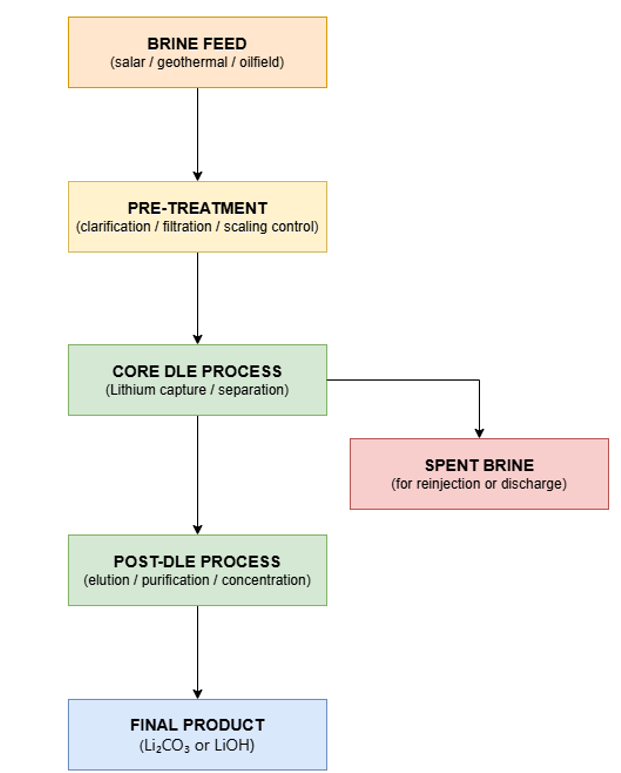
Below a process flow diagram overview of a complete DLE system:
How Lenntech supports your project
The successful implementation of Direct Lithium Extraction requires reliable downstream treatment of lithium‑rich brines generated by core DLE systems. At this stage, separation, polishing, and concentration technologies are essential to achieve stable operation and consistent lithium recovery.
Lenntech specializes in post‑DLE treatment solutions, with a strong focus on ion‑exchange (IEX) and membrane‑based technologies, supporting the separation and conditioning of lithium from already clarified and conditioned brines.
Lenntech offers:
- Brine characterization and post‑DLE concept assessment, including laboratory testing to evaluate lithium separation and polishing requirements
- Design of post‑DLE treatment systems, including multimedia filtration (MMF), ion‑exchange, ultrafiltration (UF), electrodialysis (ED / EDR), nanofiltration (NF) or reverse osmosis (RO) where applicable
- System piloting and validation to define operating parameters and optimize combinations of membrane and IEX technologies for specific lithium‑rich brines
- Integration of IEX and membrane technologies downstream of core DLE units to improve lithium selectivity, stability, and product quality
- Modular and scalable post‑DLE treatment units, suitable for high‑salinity environments and integration into existing DLE process lines
- Water and brine management solutions, supporting recirculation, reuse, or reinjection strategies after lithium separation
For more information or quotation, please contact us:  Feedback Form or call us on +31 152 610 900