

Improving the Reverse Osmosis Recovery Rate
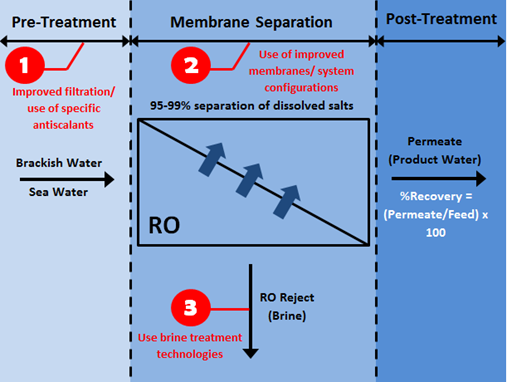
Fig.1, The basics phases of the Reverse Osmosis process scheme and the points of interest for applying strategies to improve the RO Recovery Rate
Reverse Osmosis recovery rate is mainly influenced by the quality of the feed. The contaminants are usually inorganic salts and organics which 1) raise the Osmotic Pressure (π) and 2) foul the system’s membranes.
Let’s take it a bit from the start. Water can be classified according to the Total Dissolved Solids (TDS) that it contains to the following categories,
| Water Classification | TDS (mg/L) |
| Potable | <500 |
| Freshwater (not treated) | <1,500 |
| Brackish Water (BW) | 1,500-5,000 |
| Saline Water | >5,000 |
| Seawater (SW) | >25,000 |
So the less TDS you have, the less applied pressure you need in order to push the water through the pores of the RO membranes. This is why BWRO can achieve up to 70-97% recovery (especially with new system configurations) and SWRO is limited to 35-45%. If you apply too much pressure on the membrane 1) you may create precipitation of super-saturated salts and 2) membranes have a burst pressure limit (85bar) that can’t be overcome.
The anions and cations that make up the TDS have the tendency to create mineral scaling on the surface of the membranes. This happens due to a phenomenon called Concentration Polarization which increases the concentration near the membrane surface up to ca. +20% that may lead to crystal formation and thus scaling. This causes,
- ↑ Differential Pressure (ΔP)
- ↓ Permeate Flow
- ↓ Permeate Quality
The usual suspects are sparingly soluble salts like CaCO3 (limestone), CaSO4 (Gypsum) and when we have surface waters, Barium, Strontium and Fluorides. Also we have to take into consideration low solubility compounds like the Silica concentration.
Organics create a layer on top of the membranes (biofilm) that has the same effects as scaling.
Some foulants can also cause physical damage to the membrane itself, thus decreasing it performance and life.
Scaling and biofouling are the reasons why before the feedwater reaches the membranes we apply a pretreatment which changes case-by-case but in general it’s made up by cartridge filtration, adsorption, filtering, pH adjustment and antiscalant chemicals.
Also we apply chemical cleanings (CIPs) that are performed as less as possible and are designed case-by-case.
In order to overcome the limitations of desalination, we’ve a couple of tricks up our sleeve that can be categorized as (Fig.1),
- Improved Feed Pre-Treatment
- Advanced Membrane Technology
- New Flow Configurations
- Brine Treatment Technologies
1) Improved Feed Pre-Treatment
With new membrane technologies, the feed can be rid of the problematic ions that cause scaling. A good example is the use of NF membranes for cutting of the bivalents (Ca2+, Mg2+, SO42-) that are sure to create problems for our membranes. Thus we can ensure better and more permeate for our system.
Another option is to use antiscalants. They are chemical additives that create a time delay between the bicarbonate and the formation of calcium magnesium allowing for the water to pass through the membrane before scaling occurs. Antiscalants are relatively cheap products and have no additional costs.
2) Advanced Membrane Technology
New membranes with improved,
- Active surface area
- Burst pressure limit
- Permeability
- Biofouling resistance
- Spiral wound diameter
can increase the system’s efficiency and recover water at a higher rate than their predecessors.
3) New System Configurations
The industry has come up with new system configurations that allow for,
- Concentrate Recirculation
- Concentrate Staging
- Permeate Staging
4) Brine Treatment Technologies
In the last decades there has been a lot of effort in taking as much water possible out of the RO concentrate (Brine) and many technologies have been developed leading the system to Minimum or Zero Liquid Discharge
Each of the latter optimizations can help optimizing the system and increase the water recovery rate. Our Lenntech engineers can provide you with the best solutions that will be appropriate for your case, increasing the efficiency and decreasing the costs. Call or email us and we’ll be happy to help you with your case.