

Hydrogen
The world is facing the major challenge of climate change. A growing number of countries are pledging to reach net-zero carbon dioxide (CO2) emissions with the goal of limiting temperature rise. Dramatic emission reductions are both technologically feasible and economically affordable.
There have been several waves of interest in hydrogen in the past. These were mostly driven by oil price shocks, concerns about peak oil demand or air pollution, and research on alternative fuels. Hydrogen can contribute to energy security by providing another energy carrier with different supply chains, producers and markets; this can diversify the energy mix and improve the resilience of the system. Hydrogen can also reduce air pollution when used in fuel cells, with no emissions other than water. It can promote economic growth and job creation given the large investment needed to develop it as an energy carrier from an industrial feedstock.
The energy transformation requires a major shift in electricity generation from fossil fuels to renewable sources like solar and wind, greater energy efficiency and the widespread electrification of energy uses from cars to heating and cooling in buildings.
Green hydrogen provides a link between growing and sustainable renewable electricity generation and the hard-to-electrify sectors. Hydrogen in general is a suitable energy carrier for applications remote from electricity grids or that require a high energy density, and it can serve as a feedstock for chemical reactions to produce a range of synthetic fuels and feedstocks.
Additional benefits of green hydrogen include: the potential for additional system flexibility and storage, which support further deployment of variable renewable energy (VRE); contribution to energy security; reduced air pollution; and other socio-economic benefits such as economic growth and job creation, and industrial competitiveness.
Green hydrogen is an energy carrier that can be used in many different applications (Figure 1). However, its actual use is still very limited. Each year around 120 million tons of hydrogen are produced globally, of which two-thirds are pure hydrogen and one-third is in a mixture with other gases. Hydrogen output is mostly used for crude oil refining and for ammonia and methanol synthesis, which together represent almost 75% of the combined pure and mixed hydrogen demand.
Today’s hydrogen production is mostly based on natural gas and coal, which together account for 95% of production. Electrolysis produces around 5% of global hydrogen, as a by-product from chlorine production.
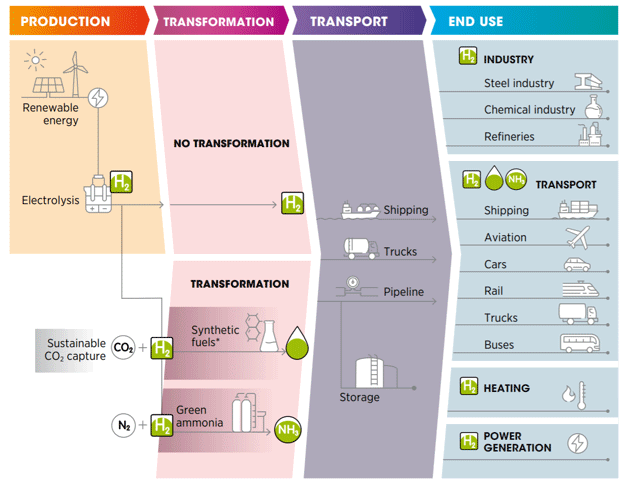
Figure 1, Green hydrogen production, conversion and end uses across the energysystem
Hydrogen can be produced with multiple processes and energy sources; a colour code nomenclature is becoming commonly used to facilitate discussion (Figure 2).
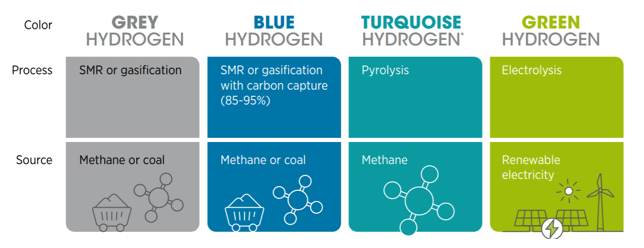
Figure 2 Selected shades of hydrogen
Among the different shades of hydrogen, GREEN HYDROGEN – meaning hydrogen produced from renewable energy – is the most suitable one for a fully sustainable energy transition. The most established technology options for producing green hydrogen is water electrolysis fuelled by renewable electricity. Other renewables-based solutions to produce hydrogen exist. However, except for SMR with biogases, these are not mature technologies at commercial scale yet. Green hydrogen production through electrolysis is consistent with the net-zero route, allows the exploitation of synergies from sector coupling, thus decreasing technology costs and providing flexibility to the power system. Low VRE costs and technological improvement are decreasing the cost of production of green hydrogen. For these reasons, green hydrogen from water electrolysis has been gaining increased interest.
Green hydrogen competes both with fossil fuels and with other shades of hydrogen. It is important, therefore, to understand the factors that determine the cost of green hydrogen.
The production cost of green hydrogen depends on the investment cost of the electrolysers, their capacity factor which is a measure of how much the electrolyser is actually used, and the cost of electricity produced from renewable energy.
By 2020, the investment cost for an alkaline electrolyser is about USD 750-800 per kilowatt (kW). If the capacity factor of the green hydrogen facility is low, such as below 10% (fewer than 876 full load hours per year), those investment costs are distributed among few units of hydrogen, translating into hydrogen costs of USD 5-6/kg or higher, even when the electrolyser is operating with zero-priced electricity. In comparison, the cost of grey hydrogen is about USD 1-2/kg of hydrogen (considering a price range of natural gas of around USD 1.9 – 5.5 per gigajoule [GJ]). If load factors are higher, however, investment costs make a smaller contribution to the per-kg green hydrogen cost. Therefore, as the facility load factor increases, the electrolyser investment cost contribution to the final hydrogen production cost per kg drops and the electricity price becomes a more relevant cost component.
At a given price of electricity, the electricity component in hydrogen’s final cost depends on the efficiency of the process. For example, with an electrolyser efficiency of 0.65 and electricity price of USD 20 per megawatt hour (MWh), the electricity component of the total cost would go up to USD 30/MWh of hydrogen, equivalent to USD 1/kg.
Given today’s relatively high electrolyser costs, low-cost electricity is needed (in the order of USD 20/MWh) to produce green hydrogen at prices comparable with grey hydrogen. The objective of green hydrogen producers is now to reduce these costs, using different strategies (IRENA, forthcoming). Once electrolysers costs have fallen, it will be possible to use higher-cost renewable electricity to produce cost-competitive green hydrogen.
Transporting hydrogen generates additional costs. Transport costs are a function of the volume transported, the distance and the energy carrier. At low volumes, the cost of transporting compressed hydrogen 1,000 km in a truck is around USD 3.5/kg. For large volumes, shipping green ammonia is the lowest-cost option and adds only USD 0.15/kg of hydrogen (without considering conversion costs, i.e. cracking). Similar low costs can be achieved using large pipelines (around 2,000 tonnes per day) over short distances. Hydrogen transport by pipeline can be one-tenth of the cost of transporting the same energy as electricity.
Today’s cost and performance are not the same for all electrolyser technologies (see Table 1). Alkaline and PEM electrolysers are the most advanced and already commercial, while each technology has its own competitive advantage. Alkaline electrolysers have the lowest installed cost, while PEM electrolysers have a much smaller footprint, combined with higher current density and output pressure. Meanwhile, solid oxide has the highest electrical efficiency. As the cell stack is only part of the electrolyser facility footprint, a reduced stack footprint of around 60% for PEM compared to alkaline translates into a 20%-24% reduction in the facility footprint, with an estimated footprint of 8 hectares (ha)-13 ha for a 1 GW facility using PEM, compared to 10 ha-17 ha using alkaline. Gaps in cost and performance are expected to narrow over time as innovation and mass deployment of different electrolysis technologies drive convergence towards similar costs.
12/12
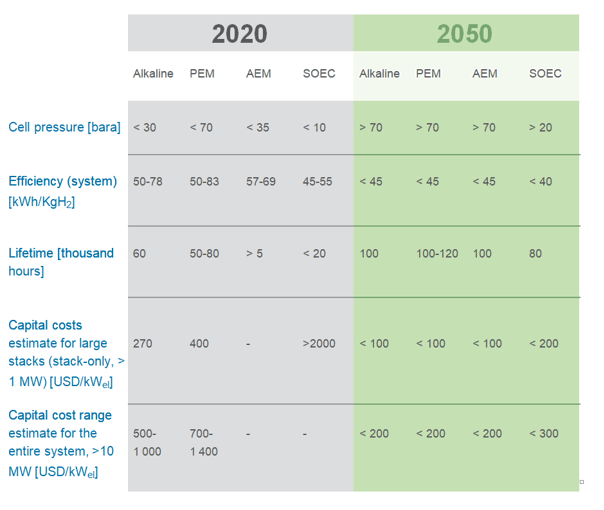
Table 1, Key performance indicators for four electrolyser technologies today and in 2050.
The electrolyser is composed of the stack (where the actual splitting of water into hydrogen and oxygen takes place) and the balance of plant, which comprises power supply, water supply and purification, compression, possibly electricity and hydrogen buffers and hydrogen processing. Both components are important for the cost, since they have similar cost shares. The largest potential for near term cost reduction is in this balance of plant, while RD&D is required to reduce stack cost and increase its performance and durability, as trade offs among these are significant.
The flexibility of alkaline and PEM stacks is enough to follow fluctuations in wind and solar. The flexibility of the system is limited, however, by the balance of plant (e.g. the compressors) rather than the stack. Furthermore, flexibility in the very short term time scales involved (i.e. sub-second) is not the key value proposition for electrolysers, as their key system value lies in bulk energy storage. This effectively decouples variability of generation from stability of hydrogen and power to X (PtX) demand through hydrogen storage in gas infrastructure (e.g. salt caverns, pipelines) and liquid e-fuels storage.
There is no single electrolyser technology that performs better across all dimensions. The future technology mix will depend on innovation and competition among key technologies and manufacturers, leading to technological improvements and a better fit for different technologies and system designs in each specific application.
Water and land use do not represent barriers to scaling up. In places with water stress, the source of water for hydrogen production should be explicitly considered in the strategies and further elaborated in project planning. Where access to sea water is available, desalination can be used with limited impact on cost and efficiency, potentially deploying multi-purpose desalination facilities to provide local benefits. A 1 GW plant could occupy about 0.17 square kilometres (km2) of land, which means 1000 GW of electrolysis would occupy an area equivalent to Manhattan (New York).
Water electrolysers are electrochemical devices used to split water molecules into hydrogen and oxygen by passage of an electrical current. They can be fragmented in three levels (see Figure 4):
The cell is the core of the electrolyser and it is where the electrochemical process takes place. It is composed of the two electrodes (anode and cathode) immersed in a liquid electrolyte or adjacent to a solid electrolyte membrane, two porous transport layers (which facilitate the transport of reactants and removal of products), and the bipolar plates that provide mechanical support and distribute the flow.
The stack has a broader scope, which includes multiple cells connected in series, spacers (insulating material between two opposite electrodes), seals, frames (mechanical support) and end plates (to avoid leaks and collect fluids).
The system level (or balance of plant) goes beyond the stack to include equipment for cooling, processing the hydrogen (e.g. for purity and compression), converting the electricity input (e.g. transformer and rectifier), treating the water supply (e.g. deionization) and gas output (e.g. of oxygen).
Purified water is fed into the system using circulating pumps, or also by gravity. The water then reaches the electrodes by flowing through the bipolar plates and through the porous transport layers. At the electrode, the water is split into oxygen and hydrogen, with ions (typically H+ or OH-) crossing though a liquid or solid membrane electrolyte. The membrane or diaphragm between both electrodes is also responsible for keeping the produced gases (hydrogen and oxygen) separated and avoiding their mixture. This general principle has remained the same for centuries, but the technology has evolved since William Nicholson and Anthony Carlisle first developed it in 1800.
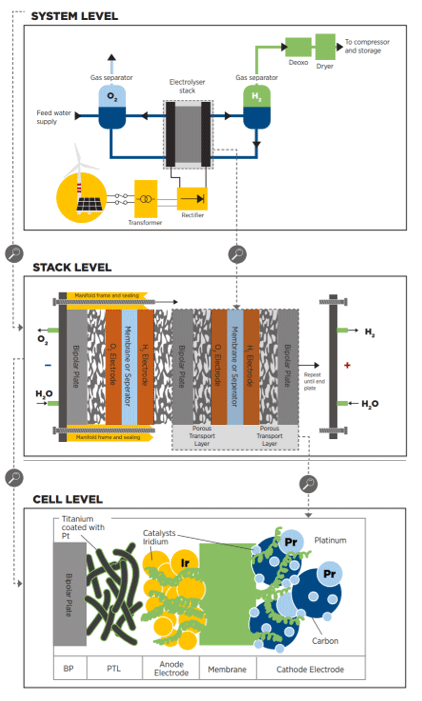
Figure 3, Basic components of water electrolysers at different levels
ELECTROLYSER TECHNOLOGIES
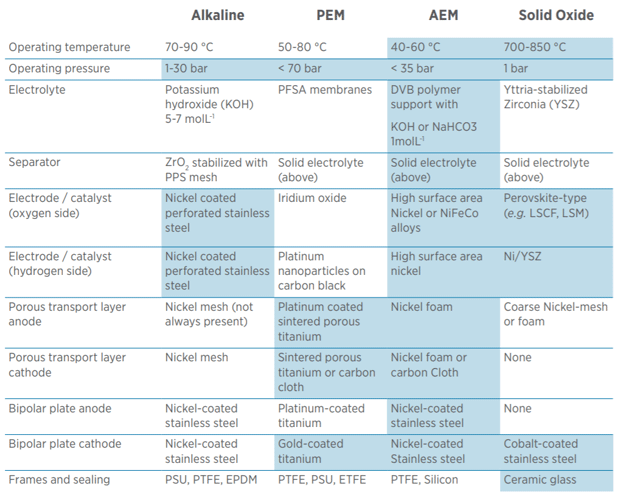
The principle of water electrolysis is simple, yet it allows the construction of different technological variations based on various physicalchemical and electrochemical aspects. Electrolysers are typically divided into four main technologies. These are distinguished based on the electrolyte and temperature of operation, which in turn will guide the selection of different materials and components.
The principles of all commercially available types of electrolysis cells are displayed in Figure 6. Many variations within each technology exist, with most radical differences being related to cell design, variation within components, and degree of technology maturity.
Solid oxide and anion exchange membrane (AEM) have high potential, but are much less mature technologies, with only a few companies and original equipment manufacturers (OEMs) involved in their manufacture and commercialisation. These are mostly based in Europe.
There are four types of electrolyser: Alkaline and polymer electrolyte membrane (PEM) are already commercial, while anion exchange membrane (AEM) and solid oxide, now at lab scale, promise a major step forward
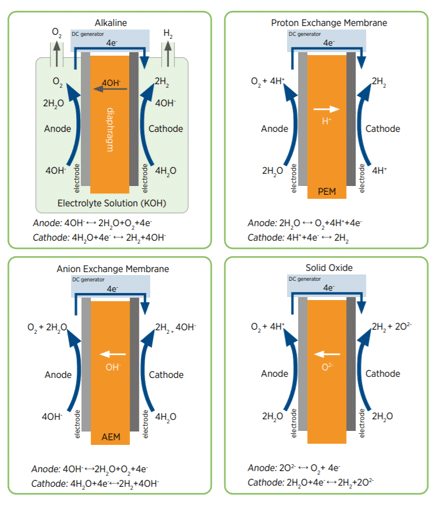
Figure 4, Different types of commercially available electrolysis technologies.
Hence, the basic principle of a water electrolysis cell consists of two electrodes separated by an electrolyte. The electrolyte is the media responsible for transporting the generated chemical charges (anions (-) or cations (+)) from one electrode to the other. In the alkaline type, the electrolyte responsible for transporting the OH-anions is typically a highly concentrated potassium hydroxide solution. The electrodes and produced gases are physically separated by a porous inorganic diaphragm (also called a separator) that is permeable to the KOH solution. In PEM, AEM, and solid oxide electrolysers, the electrodes are separated by an electron-insulating solid electrolyte, which is responsible for transporting ions from one electrode to the other and at the same time physically separating the produced gases. For these, there is no need to add a liquid electrolyte solution, and the ion transport happens within the PEM, AEM or solid oxide component.
Table 2 summarizes the operating conditions and the most important components for the four types of electrolysers. The coloured cells represent conditions or components with significant variation from different manufacturers or R&D institutions. In this respect, it also gives a sense of the less mature technologies, which is clear for the AEM and solid oxide types.
Water use for green hydrogen production
Green hydrogen production uses water as a key feedstock and renewable electricity as an energy source to separate hydrogen and oxygen from water in an electrolyser.
Water, as pure as possible, is therefore a key input. While the purity level required varies depending on the technology, the cost of water purification is marginal, starting from desalinated sea water (well below USD 1/cubic metre (m3) of water). Impurities in the water, however, will have a major impact on the lifetime of the electrolyser stack, which can in turn affect hydrogen cost by increasing the annuity of the electrolyser in the cost of hydrogen. In addition to desalination costs, the need for any water treatment in the electrolyser stack requires additional costs (e.g. deioniser). These can potentially become significant, depending on the purity level required, but are still of low impact on the overall cost of hydrogen, as in general they remain around USD 1/m3, or less than USD 0.01/kg H2.
Water use is not barrier to scaling up electrolysis. Even in places with water stress, sea water desalination can be used with limited penalties on cost or efficiency
From a pure, stoichiometric perspective, 1 kg of hydrogen requires 9 kg of water as input. Due to some inefficiencies in the process, however, taking into account the process of water demineralisation, with typical water consumption, the ratio can range between 18 kg and 24 kg of water per kilo of hydrogen. The largest water consumption is actually upstream and it is the highest when the electrolyser is coupled with PV. Water consumption for green hydrogen from PV can vary between 22 and 126 kg of water per kg of hydrogen depending on the solar radiation, lifetime and silicon content. The water scarcity is highly specific to a region since it compares the water use to the replenishment of water in the area, so local impact assessments are needed when there is hydrogen production in water-stressed regions. One of the methods to assess the impact from water use at the midpoint level is the Available WAter REmaining (AWARE) method developed by a working group of the UNEP-SETAC Life Cycle Initiative.
In terms of the impact of hydrogen production on water availability, this is clearly not an issue, as long as the assumption is that desalinated sea water is used. If freshwater is the preferred water source, a comparison can be made with current freshwater consumption for thermal power plants. Considering a very large 1 GW electrolyser, operating with an efficiency of 75% for 8,000 hours per year, the annual hydrogen production would be 0.15 million tons of hydrogen and 3 million tons of water (assuming 20 kg of water use per kilo of hydrogen). This corresponds to the consumption of water of a small city (around 70 000 inhabitants) with a consumption of 45 m³ per inhabitant. The acceptability of this will depend on the water availability at the location of the plant, with desalination remaining a key option to be part of the design of the plant, especially in water-stressed regions. The water source for large scale hydrogen production should be explicitly accounted for in hydrogen strategies, as the volumes might be significant for water-stressed regions. Desalination can, however, be deployed jointly for hydrogen production as well as other uses (e.g. human consumption and agriculture), with hydrogen production helping to increase water supply by driving the deployment of multi-purpose desalination facilities in water-stressed regions.
For the expected 19 exajoules (EJ) of green hydrogen (approximately 160 megatonnes [Mt]) in the Transforming Energy Scenario of the IRENA Global Renewables Outlook, we would require around 3 billion m3 of water per year in 2050. This is 0.08% of the current global consumption of freshwater. As freshwater is used for a multiplicity of non-energy uses (e.g. agriculture), a better comparison is the current consumption of thermoelectric power plants, which is significantly higher: for instance, the estimated water consumption by thermal power plants in the United States in the 2030 reference case was 5.8 billion m3. Even for more ambitious scenarios, where decarbonisation is faster and hydrogen plays a larger role, the overall water demand would be relatively small compared to global water consumption. Additionally, any green hydrogen produced that is used in fuel cells for transportation purposes, or eventually re-electrification, will produce ultra-pure water that could be recovered where economically feasible, in particular, in stationary applications.
Ultrapure-water-production-for-electrolyser-feed-water-for-green-hydrogen