

تقليل البصمة المائية الصناعية
The industrial water footprint is the total volume of water used across an organization’s operations, including direct process use and indirect water embedded in energy, raw materials and utilities. It is commonly assessed using the ISO 14046 methodology and includes three components: blue water (freshwater withdrawals), green water (rainwater or soil moisture use) and gray water (water required to dilute contaminants to acceptable levels).
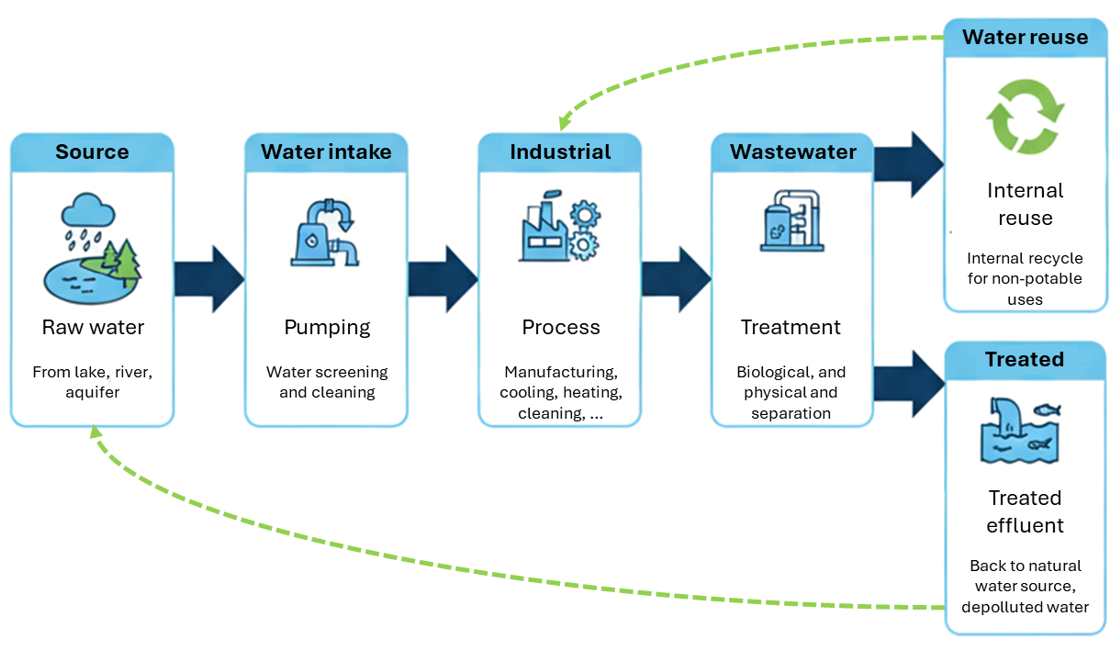
Why reducing water footprint matters across industries
Industrial facilities — including energy production, processing plants, mining sites, chemical complexes, food and beverage facilities, oil and gas operations, pharmaceutical plants and more — face growing pressure to adopt water sustainability strategies. Key drivers include:
- Regulatory requirements for water discharge, abstraction and resource protection
- Rising water and wastewater treatment costs
- Scarcity and supply risks affecting business continuity
- ESG (Environmental, Social and Governance) and corporate sustainability reporting expectations
- Reputation and stakeholder requirements regarding responsible resource use
Reducing the water footprint strengthens operational resilience, controls cost and improves environmental performance.
Typical water-intensive areas in industrial operations
Water consumption patterns vary, but common high-usage applications include:
- Cooling and heat rejection systems
- Process water used in reaction, separation, blending or washing steps
- Cleaning, washing, flushing and CIP (Cleaning-In-Place) cycles
- Boiler feedwater and steam systems
- Utility and facility services (sanitary, HVAC cooling, fire suppression)
Understanding these usage points is the foundation of process water optimization and water efficiency in industry.
Strategies for industrial water footprint reduction
Effective reduction programs typically combine:
- Water reuse and recycling through partial or full closed-loop systems
- Optimized washing and cleaning cycles to reduce rinse volume
- Cooling tower efficiency improvements and blowdown recovery
- Advanced wastewater treatment to enable safe internal reuse
- Leak detection and consumption monitoring across operations
- Selection of low-water or high-efficiency equipment
Depending on the sector and baseline usage, industries commonly achieve 20% to 90% reduction in freshwater consumption.
How reduction potential is assessed
A structured industrial water audit / balance provides the basis for improvement. Key steps required in order to assess the current used water efficiency and list possible improvements for water footprint reduction:
- Water balance mapping of intake, internal use, losses and discharge
- Sampling and analysis of key water streams
- Identification of reuse and recovery potential and quality compatibility
- Selection of treatment solutions to achieve required water quality targets
- Establishing water use KPI (Key Performance Indicator) monitoring systems
This approach ensures that reduction actions are technically sound and economically viable.
Technologies that enable water reduction
Common water management solutions include:
- Advanced Membrane systems (Ultrafiltration, Nanofiltration, Reverse Osmosis) in different configurations and with specific membrane selection to fit user’s needs (CCRO, tight UF, feed and bleed configuration, …)
- Biological treatment such as Membrane Bioreactors (Membrane Bioreactor systems)
- Ion exchange, activated carbon and polishing filters
- Advanced Oxidation Processes for trace contaminant removal
All these technologies could be delivered with Automation, flow monitoring and SCADA to ensure proper functioning and for performance monitoring. These enable stable, reliable and high-quality reuse for industrial processes.
Economic and operational benefits
Reducing water use lowers:
- Freshwater purchase and pumping costs
- Wastewater treatment and discharge fees
- Chemical and energy consumption
Depending on local water pricing and discharge conditions, Return on Investment (ROI) for water reuse and optimization projects typically ranges from 1 to 4 years.
How Lenntech Supports Your Project
Lenntech provides end-to-end support:
- Water footprint assessment and audit
- Evaluation of reduction opportunities and reuse scenarios
- Process and treatment system engineering
- System design, on-site integration and automation
- Installation, commissioning and operational training
- Long-term service, monitoring and optimization
Our solutions enable sustainable industrial water use, regulatory compliance and long-term operational savings across all industrial sectors.
For more information or quotation, please contact us:  Feedback Form or call us on +31 152 610 900