

Water & Energy Efficiency Optimization for water footprint reduction with Smart Monitoring
Industrial water treatment and reuse are increasingly energy-intensive as recovery rates rise and discharge volumes decrease.
To maintain cost-effective and sustainable operations, industries must address water and energy efficiency together, supported by smart monitoring and water balance analytics.
This integrated approach reduces operating expenditure, stabilizes performance and supports long-term sustainability goals.
Energy use in industrial water treatment
Energy consumption in a typical water treatment line is driven by mechanical and thermal processes. The most energy-intensive components are:
- Pumps for intake, recirculation and high-pressure membrane systems
- Blowers for biological treatment and aeration
- Membrane systems such as ultrafiltration and reverse osmosis
- Thermal units including evaporation, heating and crystallization in ZLD process
High-pressure pumping, aeration and thermal processes typically represent the largest share of total energy demand.
Reducing energy consumption and OPEX
Effective energy-efficient water treatment focuses on optimized design and controlled operation:
- Use of Variable Frequency Drives (VFDs) on pumps and blowers
- Selection of low-energy membrane systems such as CCRO (Closed Circuit Reverse Osmosis) with optimized flux
- Hydraulic optimization to minimize pressure losses
- Recovery loops and cascade reuse to reduce treated volumes
- Heat recovery from blowdown, condensate or thermal processes
- Optimized chemical dosing to maintain system efficiency
These measures directly reduce power consumption, maintenance needs and chemical usage, leading to lower plant OPEX. Those solutions can be implemented already during process design to ensure an optimized energy consumption.
Why measurement comes first
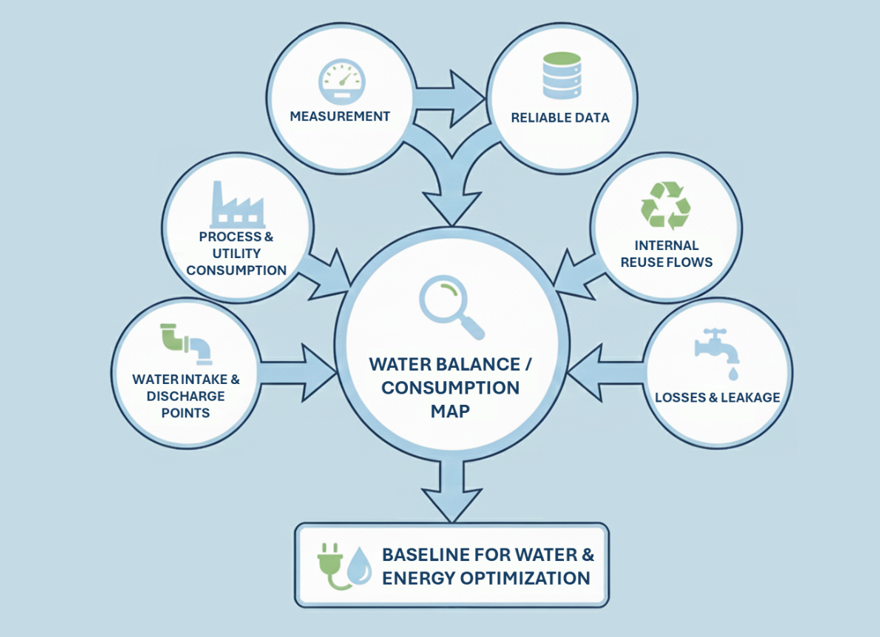
Optimization starts with measurement. Without reliable data, efficiency improvements remain assumptions. A water balance or consumption map identifies:
- Water intake and discharge points
- Process and utility consumption
- Internal reuse flows
- Losses and leakage
Smart monitoring and water balance analytics
An industrial water monitoring system uses online sensors to continuously track performance and consumption. Key parameters include:
- Flow for intake, reuse and discharge
- Pressure for pump and membrane performance
- Conductivity for salt accumulation and reuse stability
- Turbidity and Total Organic Carbon (TOC) for water quality control
- Energy consumption of major equipment
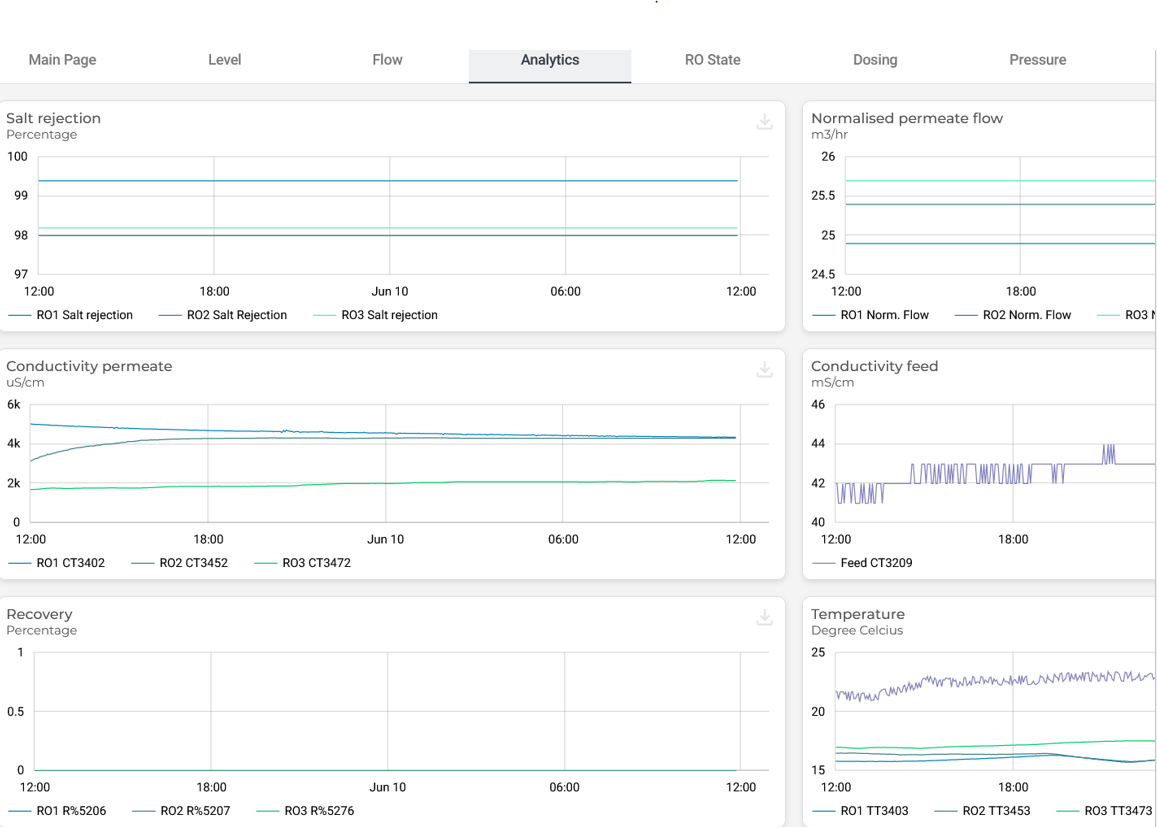
Real-time data enables continuous water balance validation and early detection of inefficiencies.
Digital dashboards, automation and control
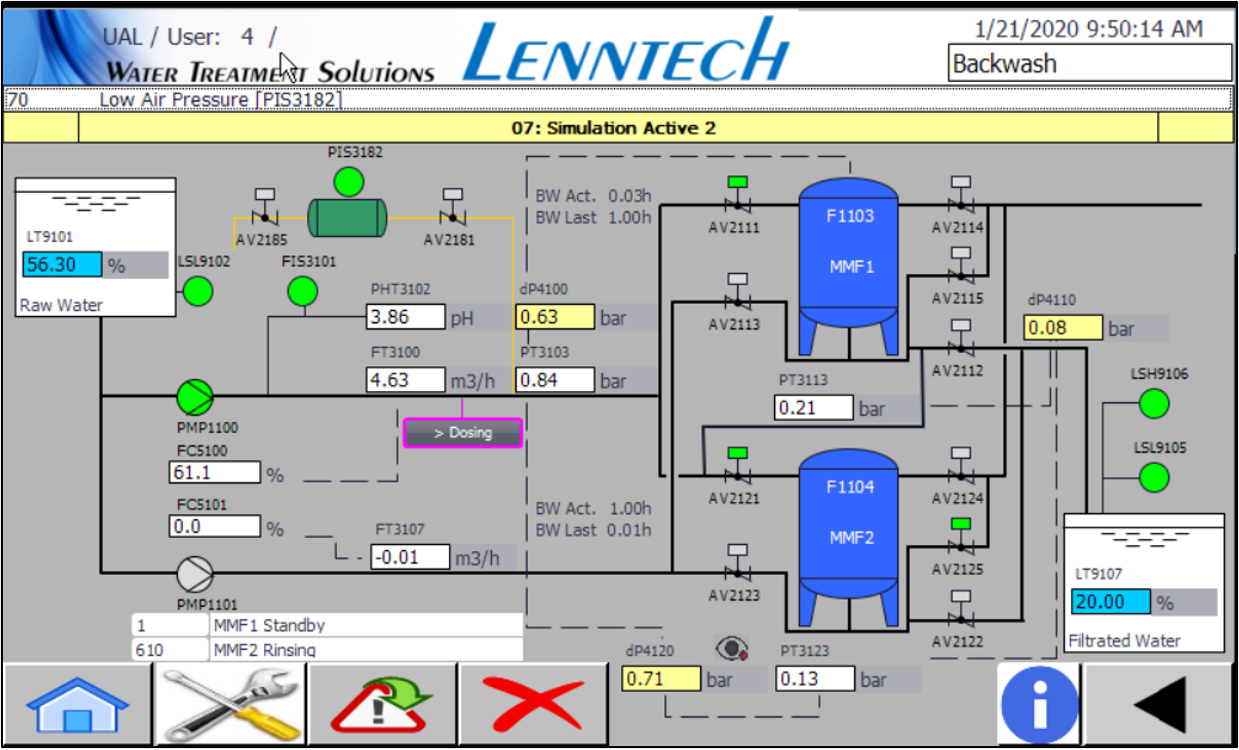
Monitoring data are visualized in digital dashboards to track Key Performance Indicators (KPIs) such as water use per unit output, energy per cubic meter treated and recovery rates.
Integration with PLC (Programmable Logic Controller) enables:
- Demand-driven pump and blower control
- Alarm management and remote monitoring
- Predictive maintenance for water treatment
- Stable operation under variable load conditions
Payback and business impact
Combined water and energy optimization typically delivers:
- 5–20% reduction in energy consumption
- 10–30% reduction in overall operating expenditure
- Typical payback periods of 6 to 24 months
Additional benefits include improved reliability, easier ESG reporting and long-term operational resilience
Lenntech’s integrated solution
Lenntech supports industries through energy and water audits, optimized treatment design, selection of energy-efficient equipment and implementation of smart water management PLC software for data monitoring.
By combining treatment expertise with digital monitoring, Lenntech enables measurable reductions in water footprint, energy use and operating cost.
For more information or quotation, please contact us:  Feedback Form or call us on +31 152 610 900