

Transitioning from Industrial Water Reuse to ZLD or MLD - Minimizing Brine, Maximizing Water Circularity
As industries progress in their water sustainability journey - reducing water footprint, optimizing processes, and implementing internal reuse - many reach the stage where most recyclable water is already recovered. The remaining challenge typically lies in managing high salinity reject streams, primarily from reverse osmosis (RO) units. These concentrated brines limit recovery and prevent complete circularity.
This is where Minimal Liquid Discharge (MLD) and Zero Liquid Discharge (ZLD) become the natural next steps.
By integrating MLD/ZLD technologies, industries can reduce freshwater intake, eliminate environmental discharge risks, and achieve near-complete water loop closure. To learn more about MLD/ZLD concept, please visit this page.
Why move beyond reuse? The need for MLD/ZLD
Even after advanced reuse (such as membrane bioreactor (MBR), ultrafiltration (UF) and reverse osmosis (RO)), industries still face challenges:
- RO reject brine accumulates salts (TDS, hardness, silica, chlorides).
- Regulatory and ESG (Environmental, Social and Governance) requirements increasingly restrict liquid discharge.
- Water scarcity and cost pressures raise the value of maximum recovery.
- Closed-loop operations become unstable without proper brine management.
ZLD/MLD bridges this gap by concentrating or eliminating the remaining liquid stream, enabling systems to reach 90–98% total water recovery.
MLD vs. ZLD – Understanding the difference
Minimal Liquid Discharge (MLD)
- Focuses on minimizing the liquid waste volume.
- Typically achieves 80–95% recovery depending on stream quality.
- Uses advanced membranes (high-recovery RO or CCRO, brine RO, EDR, FO) + selective softening.
- Lower CAPEX/OPEX compared to full ZLD.
Zero Liquid Discharge (ZLD)
- Eliminates liquid discharge entirely.
- Achieves >95–98% recovery.
- Adds thermal processes: mechanical vapor compression (MVC), multiple-effect evaporation (MEE) and crystallizers.
- Produces solid salts as final output.
Most industries start with MLD and upgrade to ZLD when water scarcity, discharge limitations, or corporate ESG policies demand it.
Which streams require MLD/ZLD?
ZLD/MLD is typically applied to:
- RO reject brine from reuse systems
- Concentrated streams with high conductivity
- Cooling tower or boiler blowdown
- High-TDS process wastewater
- Streams accumulating hardness, silica or chlorides
Before thermal or high-recovery systems, industries often require selective pre-treatment such as hardness removal, metals precipitation, antiscalant dosing or silica reduction.
Technologies that enable high-recovery, MLD and ZLD
Membrane-based (MLD)
- High-recovery RO / CCRO / Brine RO
- Electrodialysis / Electrodialysis reversal (ED/EDR)
- Forward osmosis (FO) concentrators
- Nanofiltration (NF) for selective salt removal
Thermal-based (ZLD)
- Mechanical vapor compression (MVC) evaporators
- Multiple-effect evaporators (MEE)
- Crystallizers for solids production
Essential pre-treatment
- Softening (lime, IX, pellet reactors)
- Silica and Metals removal
- pH adjustment and scaling control
How MLD/ZLD integrates with existing infrastructure
MLD/ZLD systems are often implemented after existing wastewater treatment and reuse units:
Primary/Secondary Treatment → MBR (membrane bioreactor) → UF → RO → Brine Concentration → MLD/ZLD Thermal Step
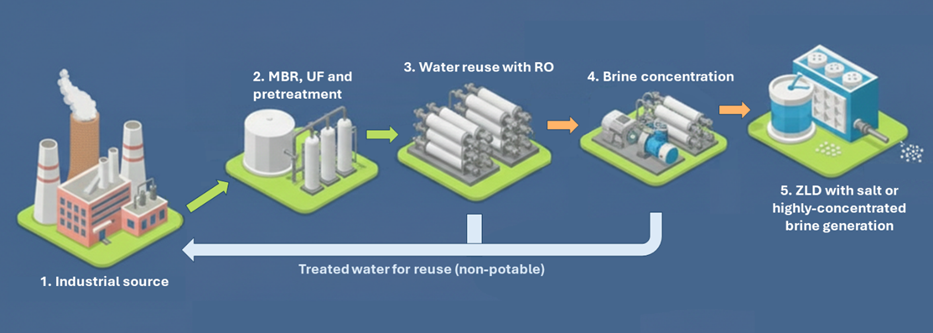
This makes the transition seamless: the existing MBR/RO plant handles the bulk load, while the new MLD/ZLD section deals only with the concentrated stream. Industries can expand in phases:
- 1. Reuse (MBR/UF/RO)
- 2. High-recovery membranes
- 3. MLD
- 4. ZLD if required
This phased pathway reduces investment risk and matches corporate sustainability objectives.
Benefits of transitioning to MLD/ZLD
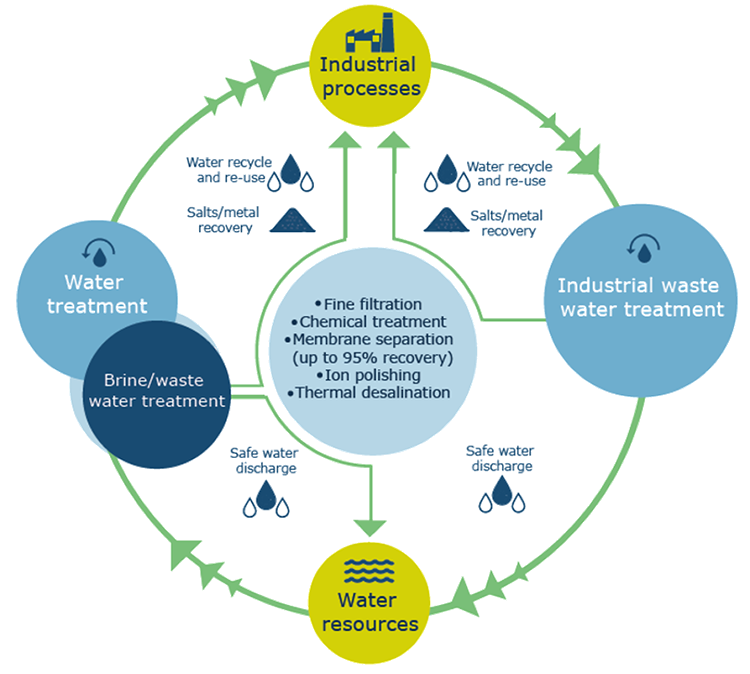
- Up to 98% water recovery and drastically reduced freshwater intake
- Near elimination of liquid discharge risk
- Compliance with stringent local or national discharge regulations
- Long-term water security for drought-sensitive regions
- Stabilized closed-loop water reuse operations
- Reduced brine disposal and transportation cost
- Strengthened ESG reporting, sustainability credentials and corporate reputation
How Lenntech supports the complete transition
Lenntech provides end-to-end engineering for industries moving from water footprint reduction to full water circularity:
- Water and brine characterization
- Recovery simulations and feasibility studies
- Upscaling study from laboratory tests to pilot and full-scale plant
- Advanced pilot testing and scaling prediction
- Complete MLD/ZLD process design
For more information or quotation, please contact us:  Feedback Form or call us on +31 152 610 900