

Cleaning in Place (CIP) strategy & optimization for membrane systems
Cleaning-in-Place (CIP) is a key operational tool to restore membrane performance when fouling, scaling, or biofouling leads to reduced permeate flow or increased pressure drop. CIP should be triggered by performance trends — preferably normalized data — rather than fixed time intervals, ensuring cleaning is both effective and economical.
When to perform CIP
CIP is recommended when normalized performance indicators show persistent deviation from baseline, such as:
- Decline in normalized permeate flow
- Increase in normalized pressure drop
- Reduction in normalized salt rejection
Early intervention based on trend analysis helps prevent irreversible fouling and excessive membrane aging.
Selecting the appropriate cleaning strategy by identifying the dominant fouling mechanism
CIP effectiveness depends on matching chemistry and procedure to the fouling type:
- Particulate or colloidal fouling → alkaline cleaners with dispersants
- Organic fouling → alkaline cleaners with surfactants
- Scaling (inorganic deposits) → acid cleaning
- Biofouling → specific disinfecting or biocidal cleaning agents
Accurate diagnosis avoids ineffective cleaning and unnecessary membrane stress.
Cleaning sequence
In many industrial applications, a two-step sequence is effective:
- Alkaline cleaning to remove organic and colloidal layers
- Acid cleaning to dissolve mineral scales
If acid cleaning is applied first, organic foulants become protonated and compacted, making subsequent removal difficult or impossible.
The sequence and conditions should always comply with membrane manufacturer recommendations.
Operating conditions during CIP
Key parameters influencing cleaning efficiency include:
- Cleaning solution pH and temperature
- Flow velocity through membrane elements
- Soak duration and circulation time
- Avoidance of excessive pressure and hydraulic shock
Proper control of these parameters improves cleaning results while protecting membrane integrity.
Example of a typical CIP Routine
Although each system requires adaptation, a standard CIP procedure generally follows these steps:
- Initial low-pressure recirculation
The cleaning solution is circulated to distribute chemicals evenly and remove loose deposits. - Soaking phase
Circulation is stopped to allow chemical action on fouling or scaling layers. - Second recirculation phase
The solution is recirculated to detach and remove loosened foulants. - Final rinse
The system is flushed with permeate or suitable water until pH returns close to neutral (~7) and conductivity stabilizes, ensuring no chemical residues remain.
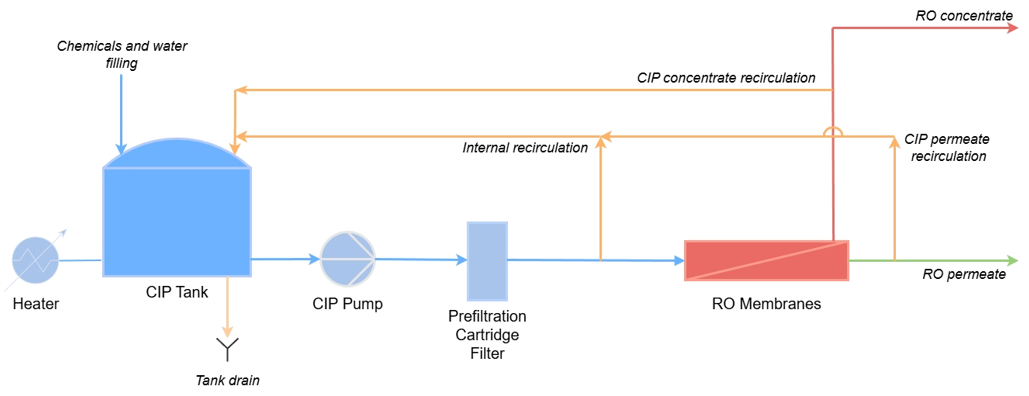
This sequence may be applied separately for alkaline and acid cleaning when mixed fouling is present. During the initial recirculation, always monitor the pH of the cleaning solution as it may vary depending on the chemical consumption and adjust if necessary.
Use of CIP Chemicals
Raw chemicals (such as citric acid or caustic soda) can be effective; however, formulated industrial CIP chemicals are generally recommended. These products contain surfactants, buffers, dispersants, and corrosion inhibitors designed to improve cleaning efficiency while remaining compatible with membrane materials.
Using dedicated CIP formulations helps:
- Improve removal of complex fouling layers
- Reduce cleaning duration and chemical consumption
- Limit membrane damage and incomplete cleaning
All chemicals should be applied within the limits defined by the membrane supplier.
Evaluating cleaning effectiveness
Cleaning success should be verified by comparing normalized performance before and after CIP:
- Recovery of normalized permeate flow
- Reduction of normalized pressure drop
- Stabilization of normalized salt rejection
If performance does not recover, fouling may be partially irreversible, chemistry or sequence may be inappropriate, or upstream conditions may require correction. Repeated ineffective CIP can accelerate membrane aging and increase operating costs.
Cleaning frequency and best practice
CIP frequency should be driven by performance trends rather than fixed schedules:
- Clean when normalized data shows sustained deviation
- Avoid excessive cleaning that shortens membrane life
- Adjust cleaning intervals based on historical trends and feedwater variability
How Lenntech can support with CIP strategy and optimization
Lenntech supports operators by reviewing normalized performance data and helping define appropriate CIP strategies, cleaning sequences, and operating conditions in line with membrane manufacturer recommendations. Remote analysis and on-site support are available to improve cleaning effectiveness, reduce downtime, and maintain stable long-term operation.
For more information or quotation, please contact us:  Feedback Form or call us on +31 152 610 900