

Performance normalization for membrane systems
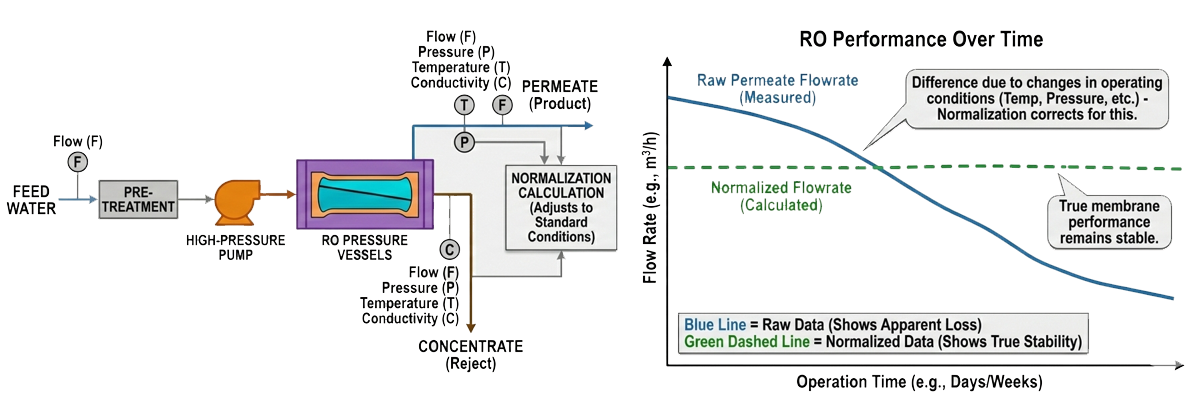
Membrane system performance cannot be reliably assessed using raw operating data alone. Changes in temperature, pressure, recovery, and seasonal feedwater variability continuously affect measured values. Performance normalization is essential because normalized data shows true membrane performance, while regular operating data reflects both membrane condition and changing operating conditions.
Without normalization, operators risk misinterpreting normal operational fluctuations as performance loss — or overlooking early degradation.
Why normalization is essential
Measured operating data is influenced by:
- Temperature variation
- Changes in recovery and operating pressure
- Variations in feedwater quality
Without normalization:
- Permeate flow changes may be wrongly attributed to fouling
- Pressure increases may appear as scaling
- CIP effectiveness may be incorrectly evaluated
Normalized data removes these influences and allows direct comparison with baseline performance.
What is performance normalization?
Performance normalization adjusts operating data to fixed reference temperature & salinity and recovery conditions defined during baseline performance definition.
It is common to use a temperature correction factor (TCF) to compensate and adjust the data to a baseline.
Normalization usually applies to:
- Reverse osmosis (RO)
- Nanofiltration (NF)
- Ultrafiltration (UF)
Key normalized indicators include:
- Normalized permeate flow
- Normalized pressure drop
- Normalized salt passage or salt rejection
- Normalized permeability
- Permeate flow normalization
- Salt passage or permeability normalization
Raw Data vs. Normalized Data
|
Raw operating data |
Normalized data |
|
Influenced by operating conditions |
Corrected to reference conditions |
|
Difficult to compare over time |
Directly comparable to baseline |
|
Reactive troubleshooting |
Proactive performance monitoring |
Only normalized data allows meaningful long-term trending and reliable troubleshooting.
Baseline definition and data quality
Normalization is only effective when based on a reliable baseline. A valid baseline should be established:
- After commissioning or membrane replacement
- After a confirmed effective CIP
- Under stable operating conditions
Consistent data logging and correct sensor calibration are critical.
Using normalized trends for troubleshooting
Normalized trends reveal performance degradation that raw data often hides:
- Declining normalized permeate flow
→ Fouling, scaling, or membrane compaction may be developing - Increasing normalized pressure drop
→ Particulate fouling or biofouling may be occurring - Increasing normalized salt passage
→ Membrane aging or damage may be present
Evaluating the trend rate (Δ% per month) is often more informative than reviewing single data points.
Normalization and CIP evaluation
Normalization is essential to evaluate CIP effectiveness:
- Confirms whether performance was restored
- Identifies partial or ineffective cleaning
- Prevents unnecessary repeated CIP
If normalized performance does not recover after cleaning, irreversible fouling or membrane aging may be present.
How Lenntech Can Support
Normalization instructions and formulas are also usually given by the membrane manufacturers. Below two examples:
- Nitto / Hydranautics for RO membranes
- Toray for RO membranes
Lenntech supports operators with baseline definition, data normalization, and performance interpretation across membrane technologies, in line with RO membrane manufacturer recommendations.
Remote services are available for data normalization and trend analysis to support accurate performance assessment and informed operational decisions.
For more information or quotation, please contact us:  Feedback Form or call us on +31 152 610 900