|
|
a) control and protection against Legionella
In the prevention and control of the microbes that cause Legionnaires' disease, chlorine dioxide has played a special role. The specific characteristics of the disinfectant make sure ClO2 that the job done where others fail disinfectant.
Biofilm in the piping can protect legionella against most disinfectants.
Chlorine dioxide however removes the biofilm and kills bacteria, spores and viruses. |
Other benefits include:
|
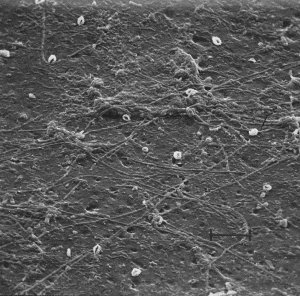
Legionella in Biofilm (©Vernagene) |
-
b) removal and prevention of Legionella
A biofilm is a layer of micro-organisms, which are embedded in a matrix (e.g., layer of sludge), which is formed in contact with water on surfaces. The settlement of pathogens in biofilms can protect it concentrations of biocides that would otherwise inhibit or kill these micro organisms when they would move freely in the water.
Biofilms provide a safe haven for organisms like Listeria, E. coli and Legionella available, where they can be reproduced continuously, until the number of microbes has reached such a higher level that contamination of substances that flows through such a pipe system is inevitable.
It is unequivocally proved that chlorine dioxide removes the biofilm in water lines and prevents it from origination when it is mixed continuously at a low level. Hypochlorite on the other hand has a detectably lesser effect on biofilms.
|
-
c) Cleaning of cooling towers
The cleaning and disinfection of cooling towers is necessary for several reasons. Most appear mostly known. By cleaning the pipes to obtain a higher efficiency in heat exchange, the lifetime of the pump system is extended and maintenance costs.
However, most people are not familiar with the fact that cooling towers pose a health risk. The warm, moist air in the cooling tower is for the growth of some pathogens ideal (such as Legionella).
The use of chlorine dioxide has several advantages:
|
-
d) air scrubbers
Scrubbers are similar in design cooling towers. The main difference between the two is that scrubbers pressurized systems while it is vacuum systems in cooling towers. In scrubbers, the water circulates. It is opposed to over the entire surface of the system gesprüht- to the airflow. The function of the circulating water is the odor-causing substances contained in the air to absorb.
Chlorine dioxide, which is added to the water cycle react, both immediately with the odor-causing substances, which have been previously absorbed from the water, as well as the substances that remain in the air to be cleaned. Normally a very low Chlordioxidrückstand is (around 0.2 mg / l) is sufficient to control the odor emission.
|
-
e) drinking water disinfection
Chlorine dioxide has been used in the disinfection of drinking water for many years (in the United States since 1944). The need arose when it was discovered that chlorine and similar substances form dangerous DPDs (disinfection by-products), such as THM (trihalomethanes).
Since then, many British and American water companies have begun to use ClO2. However, there are more reasons for the application of chlorine dioxide:
|
-
f) cleaning of vegetables and fruit
Chlorine dioxide is an excellent product for cleaning vegetables. The decisive factor is the ability to kill even at low concentrations spores, viruses and fungi.
ClO2 is a long proven product that can be used to solve some problems in the food industry. It affects neither the taste nor the odor or appearance of the food. It is safe to use and complies with the requirements for the food industry agree. Below are some examples where chlorine dioxide has been applied.
|
-
g) hot and cold water systems
Some advantages of chlorine dioxide in pipe systems with hot and cold water have already been mentioned with reference to the protection against Legionella bacteria. However, there are other advantages:
|


 Feedback Form or call us on +31 152 610 900